For alternative lenders, a card is how a credit relationship becomes a daily one.
It extends the credit line you already offer into everyday spend, turning a point-in-time loan into an ongoing source of revenue, data, and engagement. The upside is real, but so is the design work: the programme has to complement your core lending rather than compete with it, and the card infrastructure behind it has to scale as you do.
Scaling that daily relationship is where the real work lies. A card sits on top of the credit you already extend, but making it pay off, without pulling customers away from your loan products, and on infrastructure that holds up, comes down to how the programme is built.
This guide walks through what embedded cards change for lenders, who they fit, and the decisions that determine whether the programme scales.
Embedding cards into your lending platform means you don’t have to build the infrastructure alone. The way to get there is with a partner, not a from-scratch build. With a card issuing platform handling the regulated technical foundation and the issuing and processing, you keep your engineers on your lending product and still shape the card around how you actually lend. The configuration is yours, but the infrastructure is no longer your problem to build.
As a dual-regulated electronic money institution (EMI) and principal member of Visa and Mastercard, Enfuce supports lenders, banks, and mid-to-enterprise fintechs in launching and scaling credit card programmes across the EEA and UK. Drawing on a decade of experience, we break down what you need to know about scaling your lending platform with embedded credit cards.
In this guide:
- How embedded credit cards can help scale lending programmes
- Who can benefit from embedded credit cards?
- 3 key considerations before embedding credit cards in your platform
- Why choose Enfuce to power your embedded credit card programme
- How Qred launched in Sweden and scaled across Europe on one infrastructure partner
- FAQs
Contact us today to discover how Enfuce can help your lending platform scale with embedded credit cards.
Let's talkHow embedded credit cards can help scale programmes
Embedded financial services let a company offer financial products inside its own platform, so customers access and manage them where they already are rather than through a separate provider.
An embedded credit card works the same way: a branded card issued on the back of a regulated issuer or BIN sponsor, but managed entirely within the platform the customer already uses. For a lender, that means building on an existing underwriting relationship where the customer accesses a card backed by the credit line they already hold, and spends and repays without leaving the lender's platform.
Here's what makes embedding cards worth considering:
1. You’ll go from point-in-time lender to daily-use financial partner
A loan is a single moment of contact: you disburse funds, then the customer manages spend on their own from there. Embedded credit cards change that dynamic.
For lenders, an embedded card is the first step to embedded finance: it extends the credit you already offer to everyday spend, turning it into something customers reach for daily, whether at checkout or in an app. Instead of stepping back after disbursement, your lending platform stays visible as a financial services partner in all those daily transactions.
2. You’ll generate new revenue streams that add to the loan rather than replace it
Card issuing also opens revenue streams a loan product doesn't have on its own:
- Interchange is the first and most direct stream. Every card transaction generates a fee paid by the merchant's bank to the issuer.
- Instalments add further revenue through interest on instalment balances, per-plan fees, or merchant-funded instalments, where the merchant can cover the cost of offering a 0% plan to the customer, for example.
- Cashback, which is funded by interchange revenue, can be used to steer spend toward categories with higher interchange rates, thus boosting total interchange revenue.
None of these revenue streams replaces the loan. Instead, they put your existing underwriting and credit expertise to work for customers’ everyday spending needs, rather than just the larger, planned purchases loans are designed for.
3. You’ll access greater behavioural data to refine your offerings
Unlike loans, which give you a single data point at disbursement, card transactions generate an ongoing stream of granular spend data on what customers buy, where, and how often.
That creates a growing, line-item picture of spend data you can use to design more targeted products, refine underwriting, approve customers for further credit, or tailor products to real spending patterns instead of relying on loan history alone.
4. You’ll improve customer retention and loyalty
The effects above contribute to stronger customer retention. A card that's part of daily spend is harder to walk away from than a loan that’s already been drawn down. When customers can manage their card, check balances, and make payments directly through your existing platform, the card becomes another part of their relationship with your brand, without requiring you to build the entire experience from scratch.
Plus, with added features, you can deepen that relationship further. Enabling instalments, for instance, encourages customers to stay in your ecosystem rather than turn to Buy Now, Pay Later (BNPL) providers, while cashback keeps your card top-of-wallet by rewarding spend. Meanwhile, tailored products and offers further strengthen brand loyalty.
So, with those benefits in mind, who exactly can embedded credit cards work for? Let’s look at a few potential use cases.
Who can benefit from embedded credit cards?
Embedded credit cards can fit a range of lending models, including:
- Non-bank SME lenders: Lenders that have already built underwriting and disbursement for business loans can layer a card on top of that same credit relationship, turning a one-time loan into an ongoing spending line for the business.
- Revenue-based finance providers: RBF providers extend credit against future revenue. A card gives that credit a daily-use channel, so the customer draws on it as ongoing spend.
- Hybrid loan/card/overdraft products: Some lenders combine a term loan, a card, and an overdraft-style credit line into one product. A card can make the credit usable day-to-day. While the loan covers a lump sum and the overdraft covers short-term gaps, the card lets the customer spend against the credit line wherever cards are accepted.
- Platform lenders: Lenders that distribute credit through partner platforms can offer a white-label card under their partner's brand. Take a marketplace seller that relies on invoice financing. Instead of a one-time disbursement, the lender could front the funds via a marketplace-labelled card. The seller then spends daily with the card, extending its relationship with the marketplace, while the lender gains a stickier partnership with the marketplace and richer data.
- Challenger banks: Challenger banks that already issue debit cards have the financial services infrastructure and customer relationship in place to add a credit card layer. Instead of focusing on customer acquisition for a new product, they can deepen the relationship with someone already banking with them, moving that customer from a single debit product to a fuller credit relationship.
If any of this sounds like your business, embedded cards may be your next step. Here’s what to keep in mind and the challenges to expect as you plan a card programme.
3 key considerations before embedding credit cards in your platform
Card issuance adds requirements on top of the money movement you already handle. Beyond the disbursements and repayments you run today, a card programme brings in card scheme rules, the technical issuing and processing infrastructure, and a separate layer of regulatory authorisation for issuing the card itself, distinct from the permissions that cover your lending.
Here are three considerations worth getting clear on before you start.
1. Making interchange economics work without eroding your loan margin
Interchange is a genuine new revenue stream, but a supplementary one because it adds to your loan interest revenue rather than replacing it. The economics work when the card complements your loan book rather than quietly substituting for it. The risk isn't customers using the card. It's card spend displacing borrowing they'd otherwise have taken as a higher-margin loan.
The way to manage that is to give the card a defined role like using it for everyday spend while larger planned purchases remain the loan product. That takes segmentation and spend controls to shape what the card gets used for, so the two products reinforce each other instead of one eating the other's margin.
2. Deciding how to source the licensing, ledger, and compliance stack yourself
Shaping the card's role takes real control over how the programme works, which can make building it yourself look like the way to get that control. But a fully in-house programme means taking on issuing authorisation, scheme membership, a revolving credit ledger, PCI-DSS certification, fraud and dispute management, and the regulatory overhead that comes with all of it.
Both the regulatory foundation and the technical infrastructure are yours to build and maintain. That typically runs to years and significant investment, with the operational load rising as volume grows. For most lenders, the control is worth having, while building the whole stack to get it usually isn't.
Licensing and scheme access tend to be the first hurdle lenders face. You need authorisation as a bank or EMI to issue cards and hold cardholder funds, plus access to a scheme's network. Establishing this yourself is part of what makes in-house issuing such a heavy lift.
For non-regulated entities, BIN sponsorship, where a licensed, scheme-certified entity sponsors you onto its infrastructure, is typically the fastest path. It's also worth considering where you plan to operate, since you can only issue in markets where you or your BIN sponsor hold a licence, and coverage varies by provider.
As for the needed technical infrastructure – the issuing processing engine, credit ledger, fraud solution – one path is to work with an off-the-shelf provider, though that speed can come at the cost of rigidity, with limits to how you can customise the programme.
Piecing together multiple vendors is another option and gives you the flexibility to pick best-in-class solutions for each piece of the stack. However, it can open the door to coordination complexities and uneven scalability, with some vendors struggling (or pricing themselves out) once volume grows.
A modular, API-first platform can offer a middle path, letting you start with a core feature set and layer in more complex capabilities over time. This includes flexibility with how you incorporate the card into the customer experience. For instance, you could integrate the card experience via APIs as an add-on to your existing platform or build a separate branded app.
3. Preserving your own credit logic versus forcing it onto a generic ledger
You may have a distinct approach to underwriting, credit models, and repayment logic that differentiates you from your competitors. That has to carry over, with the card sitting on a credit ledger that mirrors your existing repayment logic.
The same ledger should also support other levers that differentiate your card, like cashback rewards, and instalments. Segmentation can work alongside the ledger, letting you apply those levers differently across customer groups. The challenge is that building and maintaining your own ledger from scratch is a costly, complex undertaking, while a generic ledger limits your logic. Instead, look for an embedded card provider with a ready-built flexible ledger that supports your configurations.
Why choose Enfuce to power your embedded credit card programme
The right card platform and partner should help you solve the above challenges.
Enfuce is a multi-market card issuing payment processor built for lenders, banks, and mid-to-enterprise-level fintechs looking to scale existing card programmes or launch new ones for established firms. Here’s what you can do when you partner with us:
Design a programme that complements your loans while we handle the technical and regulatory complexity
As a global issuing processor, we provide everything you need to launch and scale a credit card programme via one modular, API-first service. With us taking on the card's technical and regulatory heavy lifting, your engineers can focus on your core lending product rather than building card infrastructure.
The foundation is our issuer processing engine, which is continuously updated to stay compliant with regulations like PCI DSS, PSD2/3, and SCA.
If needed, we also offer BIN sponsorship as a dual-regulated EMI and principal member of both Visa and Mastercard. This gives you the scheme access and licensing foundation required to issue cards in the EEA and UK. As your BIN sponsor, we take on much of the regulatory burden and help clarify what obligations remain with you.
At the same time, you have granular control over the programme design. Rather than being handed a rigid, take-it-or-leave-it platform, we provide the configurability you need to build the card product you envision – one that complements rather than overtakes your loan product. You can start fast and simple, then layer on capabilities as your programme grows.
Throughout, you get end–to-end support: a customer success manager, project manager, and dedicated team from day one, reflected in an NPS of 73.
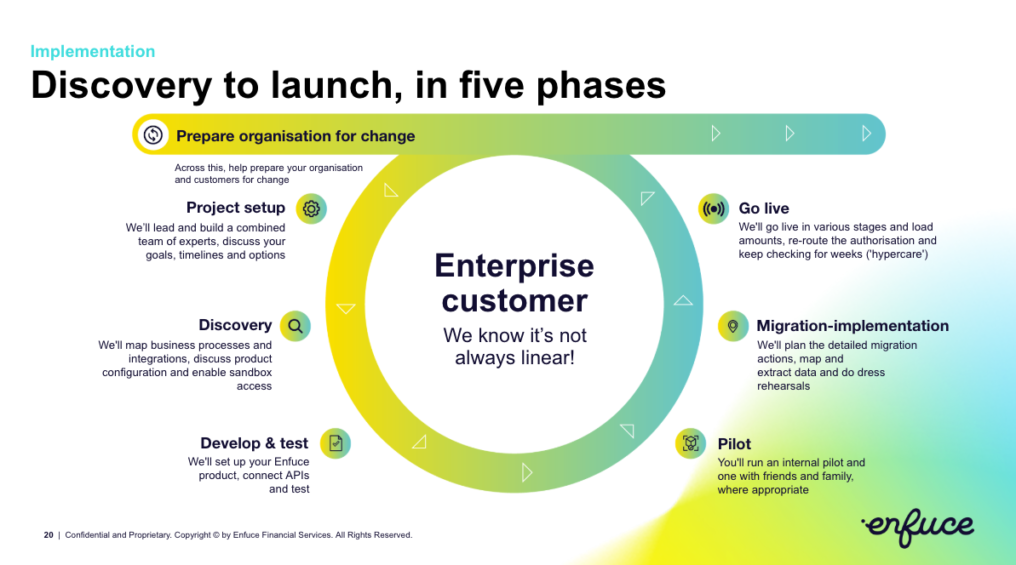
That support extends to unique product ideas, too. One lender, for example, built a hybrid product that's simultaneously a personal loan, credit card, and overdraft. Enfuce supported the combination by providing the instalments, custom repayment logic, and reminder and collection flows the product needed, with our platform chosen for our ability to handle that complexity.
Consolidate the infrastructure behind your card programme through one vendor
Embedding and launching a card programme doesn’t have to mean building the infrastructure yourself or coordinating a patchwork of vendors. With Enfuce, you get access to end-to-end card infrastructure, simplifying your stack.
Our issuer processing engine, with real-time authorisation and transaction processing, sits on top of a revolving credit ledger that maps directly to how lenders operate. Through real-time APIs and the MyEnfuce portal, you can configure the capabilities that make your programme distinct, including customer segments, cashback, instalments, and advanced spend controls.
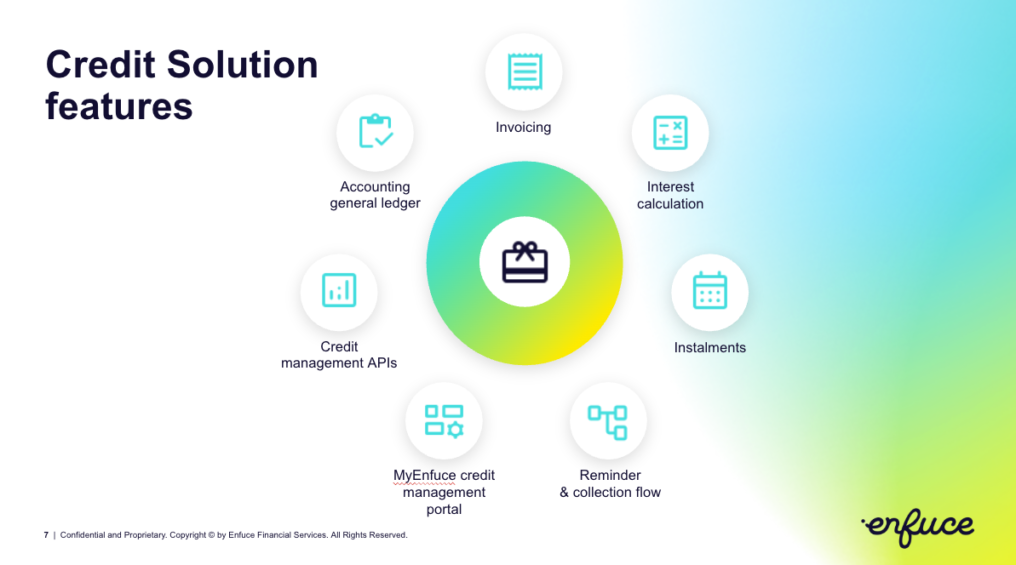
APIs and webhooks give you access to card, balance, transaction, and notification data, so you can build the card experience into your own app or customise and launch a third-party white-label card management app.
Additional modular services include:
- MyCard: A fully managed physical card service covering design, scheme approval, production, personalisation, and delivery, all connected via API.
- Fraud and dispute management: End-to-end financial crime prevention and dispute handling, combining automated decisioning with operational case management.
- Embedded Analytics: Ready-to-use analytics built from your source-of-truth card data, with the warehouse, models, and dashboards managed as a service.
With 99.999% uptime and dedicated processing, storage, and risk controls per programme, the platform is built to scale. Whether you’re running 10,000 cards or 10 million, it handles volume spikes, multi-market expansion, and the edge cases that come with growth.
Run your own repayment logic on a flexible credit ledger built for how you operate
Your credit model is part of what makes your embedded lending proposition different. Your card should work the same way.
Enfuce’s Flexible Credit Ledger handles the complexity behind your credit accounts while giving you control over how credit behaves, from interest calculations and balance buckets to minimum payment (MTP) calculations and payment priorities.
The ledger also supports features such as instalments and cashback, while our wider issuing processing engine gives you segmentation and advanced spend controls, which restrict transactions at the point of authorisation. Together, these capabilities give you the flexibility to build a card product around your specific customer and strategy.
You can configure and manage these mechanics in real time through the MyEnfuce portal, without relying on support tickets or back-and-forth with an account manager.
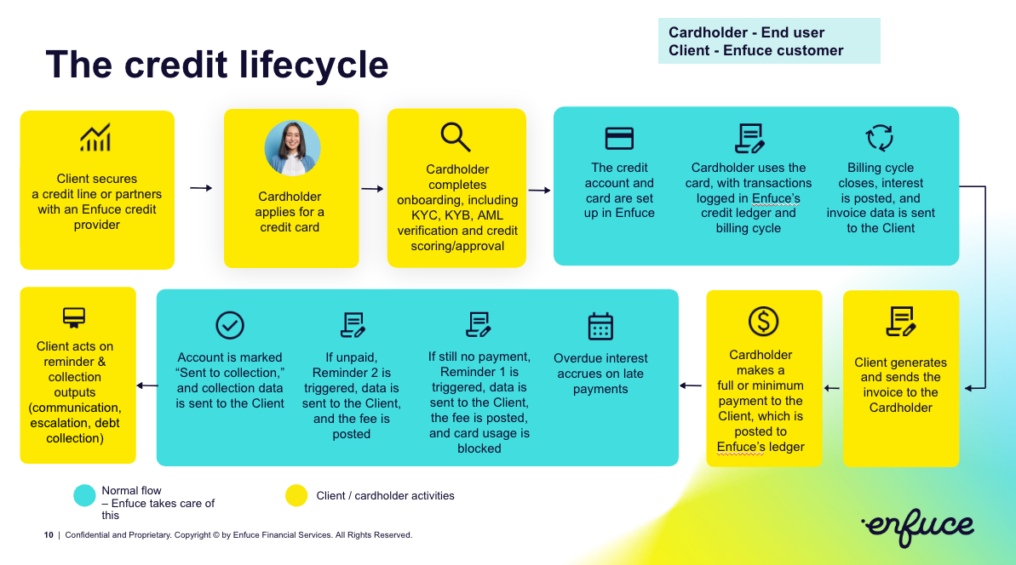
Ultimately, our ledger is designed to support your embedded lending model, not dictate it. You keep control over the logic that makes your product yours, while Enfuce handles the complex infrastructure required to make that logic work at scale.
How Qred launched credit cards in Sweden and scaled across Europe on one infrastructure partner
Founded in 2015, Qred is a fintech specialising in business financing. It launched the Qred Card to address a familiar problem for small businesses: limited access to traditional business credit cards. The Qred card gives businesses instant access to flexible credit, with the Qred app providing tools to monitor spending, set limits, and block cards.
Enfuce provides the infrastructure behind the programme, handling card processing and fraud and dispute management, alongside APIs for virtual cards, cardholder data, PIN selection, and Apple and Google Pay digital wallet integration.
With international expansion in mind from the start, Qred used Enfuce to pilot quickly in Sweden, validate the proposition, and then configure the features needed for a broader European rollout.
As Qred explains: “Despite there being a turnkey solution with tested building blocks, some tailoring is needed for each market. First, you run a quick pilot to ensure a smooth entry. Then, you can create versatile features for multiple purposes. It’s all about moulding, switching and configuring.”
The result is a card programme Qred can continue to take into new markets without having to rebuild its card infrastructure from scratch each time.
Scale your lending business with embedded credit cards
Embedded credit cards can give lenders a foothold in embedded finance: a new way to turn an existing credit relationship into an ongoing source of spend, revenue, and customer engagement. But the value depends on getting the programme design right, from avoiding cannibalisation to preserving your credit logic and choosing an infrastructure model that can scale.
Enfuce gives you the infrastructure and flexibility to do that without taking focus away from your core lending products. With configurable credit mechanics, modular card capabilities, and end-to-end processing and regulatory support, you can build a card programme that helps scale your lending platform to new heights.
Ready to explore what an embedded credit card could look like for your lending business?
Let's talkFAQs on embedded credit cards
How long does it take to launch an embedded credit card program?
With a card issuing payment processor like Enfuce, launch can take months instead of years. Enfuce provides the regulatory foundation and compliant technical infrastructure needed to issue cards and process embedded payments, all built on a flexible credit ledger. Because the platform is modular, you can start with a simple program that launches in weeks, then layer in more complex capabilities, like spend controls and segmentation, once you’re live.
Does a lender need to become a licensed card issuer to launch a credit card program?
Not necessarily. Launching a card involves two permissions: authorisation to issue it, and permission to provide the credit. A BIN sponsor covers the issuing side, but the credit must still come from an authorised lender, either you or a partner. In the UK, your BIN sponsor needs UK FCA authorisation; in the EEA, authorisation can passport across countries.
What are the benefits of launching an embedded credit card for a UK alternative lender?
Cards let UK alternative lenders extend their existing credit line to customers' daily spend, not just large, planned purchases, which helps to deepen the lending relationship. Cards also open new revenue through interchange, instalments, and cashback, generate granular spend data to inform strategy, and strengthen customer retention.
Interested to explore more? Let’s talk
Enfuce is a global card issuing payment processor built for banks and mid-to-enterprise-level fintechs, lenders, and fleet and mobility providers looking to scale existing card programmes or launch new ones.

