For an alternative lender, a credit card is a natural extension of the lending relationship – a way to turn a point-in-time loan into an everyday product. But whether it strengthens the relationship comes down to one decision: how to build a card programme that meets the standards your customers already hold you to.
Building your card infrastructure in-house gives you control, but can take years and significant investment, while pulling engineers and resources away from your core business. A turnkey card solution can remove much of the work, but then you need to find a partner with a flexible ledger that can support the way you actually lend, rather than forcing you into a one-size-fits-all framework.
The right approach gives you the best of both worlds: the infrastructure and regulatory foundation to launch without building everything from scratch, alongside the flexibility to fit your credit models, customer experience, and programme around your business.
As a dual-regulated electronic money institution (EMI) and principal member of Visa and Mastercard that's powered credit card programmes across the UK and Europe, we can help you strike that balance.
This guide walks through how to launch a credit card programme as a UK alternative lender, including the infrastructure and regulatory groundwork you need, what decisions should shape your approach, and how a partner like Enfuce can take on the heavy lifting while letting you launch a card programme that ultimately strengthens customer satisfaction and trust.
Table of contents:
- A step-by-step guide to launching your own credit card programme
- How a card product supports lender growth
- Key considerations before launching a credit card programme
- How Enfuce helps alternative lenders launch a credit card programme
- How Funding Circle grew its FlexiPay programme with a business credit card powered by Enfuce
- FAQs
Contact us to learn how you could launch a credit card programme in weeks.
Let's talkA step-by-step guide to launching your own credit card programme
As a lender, you likely already have some combination of a credit line, FCA lending permissions, AML and KYC/KYB processes for customer due diligence, and collections and customer-facing interfaces in place. What follows is specific to the card layer on top of that: the additional infrastructure, regulatory steps, and design decisions you need to launch a credit card programme.
The steps and considerations below can help you make decisions that avoid adding complexity to an already fragmented setup while giving customers a card experience that strengthens relationships and drives greater loyalty.
1. Define your goals and audience
Start with the role this card is meant to play, your timeline and who it’s for. This step shapes what you need from your approach, making it less about whether the card matters, and more about how you get it live:
- The card’s role. A card extends your lending relationship because it creates a new revenue line and a daily touchpoint on top of the credit you already offer. The question is how far it sits from your core. If issuing is becoming a product you want to own end to end, building in-house may be worth the investment. If the card’s job is to deepen an existing credit relationship, an issuing partner gets you there quickly while allowing your engineers to stay on your lending roadmap.
- Your timeline. If being first to market matters, capturing demand and strengthening your position with existing customers, you'll want an approach that launches in months rather than spending that time building and integrating infrastructure yourself. Where speed is less pressing, there's room for a more bespoke build.
- Your customers. A standard card for a broad base is well served by an issuing platform out of the box. But the more your segments and credit models differ in terms, pricing or repayment logic, the more your approach has to flex to match them. That's less about owning the infrastructure and more about whether a platform can be configured around how you lend.
2. Build or source your card infrastructure
The next order of business is setting up the infrastructure needed to run a card programme. Getting this wrong can mean spending years and tens of millions building a system that doesn’t deliver what you need, or ending up with rigid capabilities that don’t adapt to your credit model or credit risk framework, both of which can undermine rather than strengthen what you’ve already built.
Here are the core capabilities you’ll need:
- Issuing and processing engine: This is the technology, typically run by an issuer processor, that powers your programme end-to-end, from card creation to transaction authorisation, processing, and settlement. It connects to the card scheme and needs to be PCI-DSS compliant.
- Credit ledger: This system keeps a detailed record of accounts, balances, interest calculations, payment priorities, and any money movement related to the credit you offer. While the ledger itself doesn't run collections or manage the customer relationship, it should integrate with those workflows and communicate information around what’s due, when it’s due, when it’s overdue, when it’s been paid, and so on.
- Fraud and dispute management solution: This covers financial crime prevention, dispute handling, and chargebacks, protecting your programme through fraud detection, automated decisioning, and operational case handling.
- Digital wallet enablement and provisioning: For virtual cards and physical cards to work in Apple Pay, Google Pay, and similar wallets, you'll need integrations with card schemes, tokenisation services, and individual wallet providers.
- Physical card production and distribution: This includes manufacturing, personalisation, fulfilment, and delivery, as well as managing replacements, renewals, and inventory.
How you source these capabilities is up to you. You can develop these capabilities in-house, bring in different vendors for each piece, or partner with a turnkey solution that covers the whole stack. Each option comes with a different balance of cost, speed, and control, which is worth weighing before you commit. We’ll look at the trade-offs between these approaches later.
3. Establish your regulatory issuing foundation
To issue cards compliantly in the UK, two things have to be in place, regardless of whether you hold them yourself or access them through a partner:
- Scheme access with Visa and Mastercard, which lets you create and issue branded payment cards and connects you to the network that authorises, clears, and settles transactions.
- FCA authorisation to issue the card as a payment instrument. This sits under the Payment Services Regulations 2017 (held as a payment or e-money institution) and is separate from the consumer credit permissions that cover the lending itself. A credit card needs both.
There are two main ways to put these in place, with the choice largely coming down to how much independence you want versus how quickly you want to get to market.
1: Obtain your own membership and licence
You obtain direct scheme membership with the payment network. Additionally, you need to get a banking or EMI licence from the FCA to issue the card, which is a separate authorisation from any FCA lending permissions you already hold. These are serious undertakings that require a certain level of capital and can easily take 12 to 18 months or more of regulatory process.
2: Get access through BIN sponsorship
A BIN sponsor is a regulated financial institution that acts as the licensed issuer on your behalf, giving you access to the schemes and regulatory capability to issue cards, so you don’t have to obtain your own membership and licences. The BIN sponsor acts as the intermediary between your company, the card networks, and the regulatory authorities, reducing the regulatory and compliance complexity involved in launching a card programme.
We’ll explore the trade-offs between these approaches and how to decide which is right for your business below.
4. Card design and development
With your infrastructure and regulatory foundation in place, you can start designing the card product itself. The key consideration here is flexibility. Your card infrastructure and credit ledger need to support the way you already lend, rather than forcing you to change your existing credit model to fit the technology. That means being able to configure core terms such as:
- The billing cycle and due date structure
- How interest is calculated
- How the minimum payment is calculated
- The payment allocation rules that determine how payments are prioritised across balances
- Grace periods
These parameters can then be tailored to different customer segments. Ultimately, the more your customer segments and credit models differ, the more your ledger has to hold all of it (different terms, different logic) in one place, configured around how you lend rather than forced to work around it.
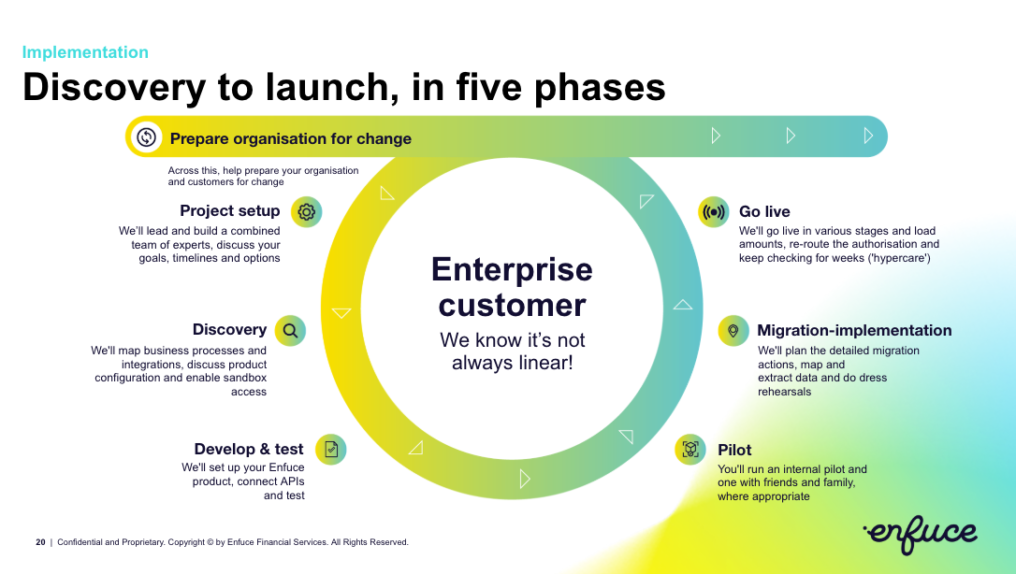
5. Run a pilot, implement, and go live
The go-live is where everything you’ve built starts reaching customers. So the goal at this stage is a controlled rollout with no surprises. Before launching fully, run an internal pilot and friends-and-family pilot (where appropriate) to catch issues early.
If you're moving an existing programme to a new provider, you'll then need to perform a structured migration to extract, load, and reconcile data from your existing systems onto the new platform.
From there, run dress rehearsals, including a rehearsal of the migration cutover (where applicable), to confirm everything works end to end, then go live in stages, releasing gradually across segments and load amounts rather than all at once. Once live, move into a hypercare phase, where you closely monitor transaction flows, system performance, and resolve incidents quickly as they arise.
How a card product supports lender growth
So that's what it takes to launch a credit card programme, but what do you actually get for the effort? A card enables you to wrap a branded, everyday spending product around your existing credit line, turning a point-in-time loan into a daily-use financial relationship. That brings benefits such as:
- New revenue streams: Branded credit cards open up revenue streams you can't reach with a loan alone, including interchange fees, instalment revenue, and annual fees.
- Deeper customer relationships: Cards turn a point-in-time loan into a daily-use financial relationship, improving customer retention and building greater stickiness and loyalty than a one-off transaction.
- A spend-data flywheel: Regular card use generates data (on cardholder behaviour, which retailers they spend with, how often they transact). That data sharpens the product, which drives more engagement and more data, keeping the cycle going.
These benefits aren’t automatic, though. The decisions behind your programme, from the infrastructure and regulatory model to how you design the product, will determine how effectively you realise the above advantages and strengthen your overall value proposition. The next section looks at the key considerations to weigh before you get started.
Key considerations before launching a card programme
Now that you’ve seen what it takes to launch a card programme and the potential benefits it can bring, the next step is understanding the trade-offs behind the key decisions. There’s no single right way to build a card programme because the best approach depends on your business goals, strategy, resources, and how you want the card to fit into your existing lending business.
A few questions can help clarify what that looks like for you:
Build vs. partner: What makes sense for your resources and timeline?
Building card infrastructure internally requires ongoing investment in engineering, maintenance, compliance, and updates as requirements evolve. Partnering with a card issuing platform shifts more of that work to a provider, but comes with its own ongoing costs.
Rather than looking only at the upfront price of either option, consider the total cost of ownership alongside how quickly you need to get to market. This can help you weigh the tradeoffs based on your resources and timeline.
How much flexibility do you need?
Not every card programme requires the same level of customisation. Standard issuing and processing capabilities may be enough for you, or you might want more visibility into the card lifecycle, configurable credit products such as store cards, or custom operational workflows.
Getting clear on those requirements early can help you determine whether a more standardised platform will be sufficient or whether the flexibility of a configurable, modular approach is necessary to support your credit model, give you the ledger flexibility you need, and accommodate your existing operational workflows.
How do you want to approach issuing?
Understanding the trade-offs between BIN sponsorship and obtaining your own issuing licence upfront can help you avoid taking on more regulatory complexity, cost, or operational responsibility than makes sense for your business.
BIN sponsorship generally reduces complexity and accelerates launch. Though it’s worth noting BIN sponsorship doesn’t offload your obligations for customer onboarding. KYC/KYB and customer due diligence remain your responsibility.
On the other hand, obtaining your own authorisation and scheme membership provides greater independence but requires additional regulatory investment and ongoing compliance responsibilities. It’s a serious undertaking that requires a certain level of collateral and can easily take 12 to 18 months or more of regulatory process.
Neither approach is inherently better. Your decision should reflect your growth plans, available resources, and desired level of control.
However you approach the questions of build, flexibility, and issuing, the right partner can help you navigate these trade-offs rather than forcing you into a single model.
How Enfuce helps alternative lenders launch a credit card programme
If partnering with a provider makes sense for your programme, the next step is finding one with proven UK experience and the flexibility to support how your business uniquely operates.
Enfuce is a multi-market card issuing payment processor built for lenders, banks, mid-to-enterprise-level fintechs, and fleet and mobility providers looking to scale existing card programmes or launch new ones. In the UK, we’ve helped lenders like Funding Circle launch credit card programmes, with additional programmes live across the Nordics and Europe. Our Flexible Ledger is designed to accommodate different credit products, customer segments, and programme requirements.
With us, you can:
Launch quickly on robust infrastructure and stay focused on your core business
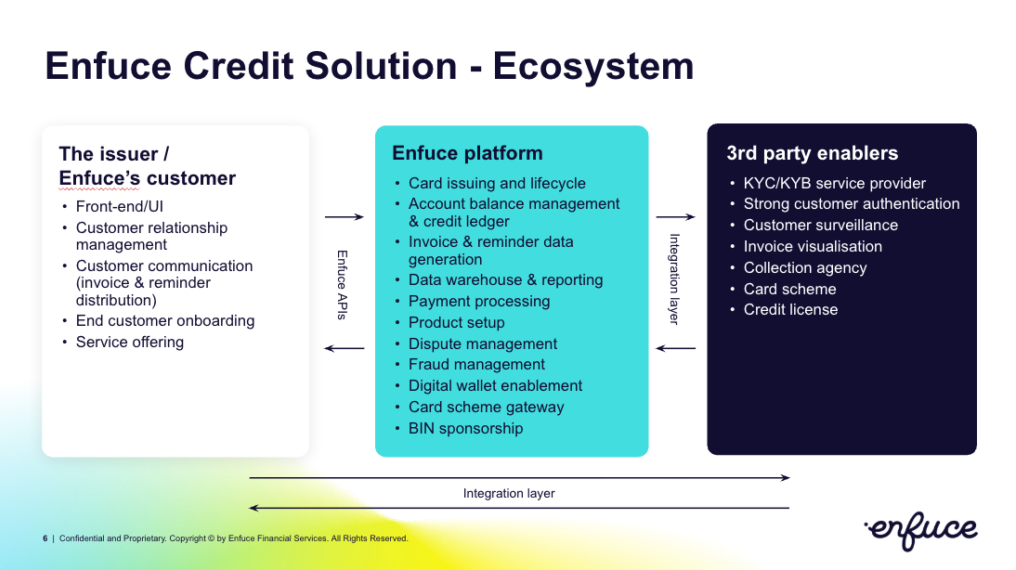
Enfuce brings the core components of a card programme together through one modular, API-first solution, so you don’t have to build and manage every part of the stack yourself. This directly addresses the cost and resource burden of building card infrastructure in-house, while giving you the components you need to launch and run your programme. Our infrastructure includes:
- PCI-DSS certified issuing and processing platform with real-time authorisation and transaction processing
- Flexible credit ledger to support your programme’s credit logic and requirements
- Fraud prevention and dispute management services
- Digital wallet enablement and provisioning
- Physical card production and lifecycle management with transparent per-card pricing
- BIN sponsorship, when needed, which lets you issue Visa- and Mastercard-branded cards in the UK and EEA, satisfying scheme rules and regulatory obligations
The result is a way to bring a programme to market without building in-house or juggling multiple vendors for each capability. What might otherwise become a 12- to 18-month (or longer) project can instead be brought live in weeks, enabling you to focus on your core business.
At the same time, you maintain control over how your programme works. Our modular, API-first infrastructure lets you configure the programme around your business and requirements, rather than forcing you into a one-size-fits-all setup.
For example, when a leading UK SME lender expanded into corporate credit cards, it needed a processing partner that could support the programme at scale. Enfuce provided the real-time transaction processing, spend monitoring, and fraud controls on a scalable, compliant cloud infrastructure aligned with UK regulatory standards, which was what the lender needed to launch the corporate card programme without building and maintaining that infrastructure in-house.
Run a card programme on a ledger that adapts to your credit model
The ledger is where a card programme either fits how you lend or works against it. A credit-native ledger lets you run instalments, hybrid structures, and segmented terms from the start and reshape them as your products evolve, rather than re-platforming a year in.
Enfuce's Flexible Ledger is credit-native by design, supporting revolving credit, charge card structures, configurable interest, instalments, invoicing, reminders, collections, repayment terms, and real-time balance tracking. That means you have the flexibility to build credit products around your model.
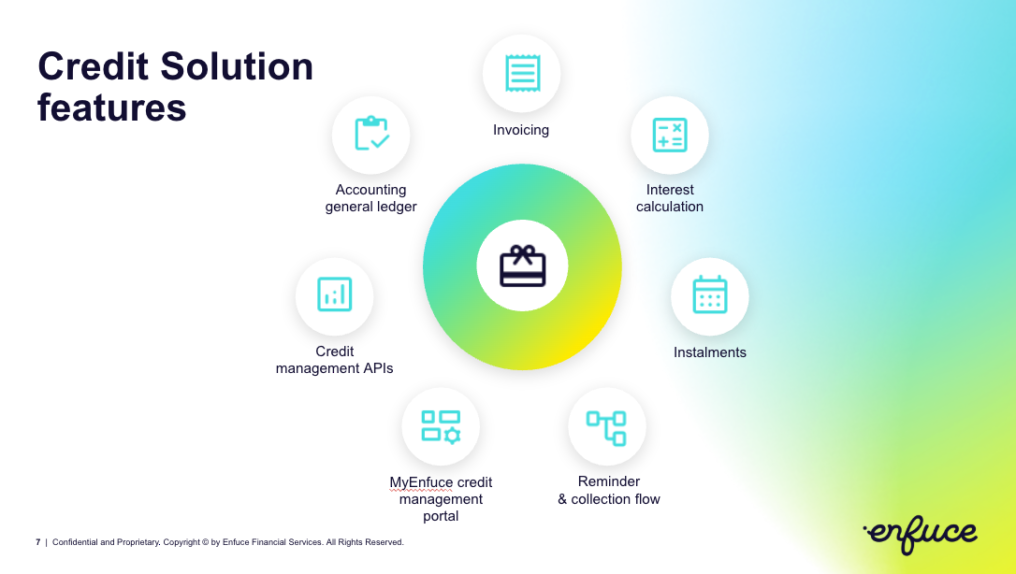
That flexibility was important for one alternative lender whose card product combines a personal loan, credit card, and overdraft in a single account. Enfuce’s support for instalments, custom repayment logic, and reminder and collection flows gave the lender the processing capabilities needed to support those different credit behaviours within one product.
The same ledger flexibility enables segmented configurations, where you can set different terms for different groups. For instance, this could mean offering different APRs based on credit score to long-standing customers versus new ones or different account fees to freelancers versus SMEs. One UK lender used Segments to offer tiered cards with different pricing for high-spend customers without creating a separate programme for each group.
You can also configure rewards such as cashback within the ledger. Cashback rates can vary by merchant category or customer segment, with promotional rates for limited-time campaigns and caps or limits per transaction, month, or category. By returning value directly to customers through cashback, you encourage greater card usage, higher spend, and stronger customer retention while helping attract new customers to the card.
Grow with a partner that reinforces what already works
A card should build on the relationship you’ve earned through lending. That’s why Enfuce works as an extension of your team, staying close to the customer experience as you launch and scale.
That’s why Enfuce works as an extension of your team, helping you protect the customer experience as you launch and grow your card programme.
You’ll have a named and accountable team spanning solution consulting, implementation, relationship management, customer success, and fraud and dispute management. Rather than handing you off to a ticket queue after launch, our team stays involved to address issues as they arise and adapt to your evolving strategy.
Qred offers one example of how that partnership can work in practice. The Nordic fintech, which provides financing to small businesses and entrepreneurs, turned to Enfuce for the flexibility and product expertise it needed to launch a business credit card in 2021. Since then, the programme has continued to grow, with expansion into the Netherlands and Germany planned next.
That kind of expansion is made easier with our API-first, modular platform, which lets you add capabilities as needed without rebuilding or re-integrating your programme. Whether you need multi-country and multi-currency support or want to introduce new card types, you can expand your programme without having to find and integrate another provider when your strategy evolves.
How Funding Circle grew its FlexiPay programme with a business credit card
Funding Circle is a UK digital lender that helps small businesses access fast, flexible finance with its FlexiPay programme. Wanting to extend FlexiPay’s instalment and liquidity features beyond invoice matching, the lender expanded its offering in 2023 with a business credit card that gives SMEs easier access to working capital.
Enfuce supported the programme by moving FlexiPay’s credit ledger onto our platform, enabling Visa credit card issuance, and providing PCI-DSS-certified issuing and processing. Funding Circle also used our MyCard service to consolidate supplier relationships and simplify the production and distribution of physical cards.
“We’re really excited to have launched FlexiPay to help small businesses manage their cash flow, which we know is one of their biggest pain points. We’ve expanded our offering to meet more customer needs by giving them more ways to spend. We’re pleased to be partnering with Enfuce in launching the card.” — Jerome Fernandez, Managing Director of FlexiPay at Funding Circle
The resulting FlexiPay card gives SMEs a flexible way to access working capital for everyday business expenses, including supplier payments, stock, equipment, and energy costs. The broader FlexiPay programme continued to grow, with transactions increasing 66% to £815 million in 2025.
Learn more about how Enfuce helped Funding Circle launch its small business credit card.
Launch a credit card with Enfuce’s issuing and processing stack delivered as one modular, API-first service
Launching a credit card can open new revenue streams, deepen the everyday relationship you have with your customers, and provide the kind of spend data that can help you optimise your core product over time.
For many alternative lenders, the ideal path to launching a credit card will let you focus on your core lending product while someone else handles scheme relationships, compliance with regulations and scheme requirements, and issuing and processing – all without locking you into a rigid, one-size-fits-all payment services platform.
Enfuce is a modular, credit-native platform that can get you live in months rather than years and is designed to keep you in control of how the programme works. The result is a card that does what your customers are already reaching for, and does it in a way that aligns with and grows your lending business.
Contact us to explore what a credit card programme could look like for your lending business.
Let's talkFAQs on how to launch a credit card
How do you launch a credit card programme?
Start by defining your target customers and the role the card will play in your existing lending business. You’ll then need to build or get access to issuing and processing infrastructure, a credit ledger, fraud and dispute management services, digital wallet enablement services, and physical card production. You’ll also need to establish scheme access and the appropriate regulatory foundation before configuring, testing, and launching the programme.
How long does it take to launch a credit card programme?
The timeline depends on how much you build yourself, the regulatory route you take, and the complexity of your product. Building the infrastructure and establishing your own regulatory and scheme relationships can take significantly longer. Working with an established provider can shorten the process considerably. For instance, as a dual-regulated EMI, BIN sponsor, and issuing processing platform, Enfuce can bring card programmes live in weeks rather than years.
Do UK alternative lenders need FCA authorisation to launch a credit card?
Launching a credit card requires both the appropriate permissions to provide the credit and to issue the card as a payment instrument. If you’re already an FCA-authorised lender, you may have the consumer credit authorisation (FCA lending permissions) needed for the lending side, but would still need permission to issue the card.
You can obtain the authorisation yourself by applying for a banking or EMI licence, which is a separate authorisation from your FCA lending permissions, not an extension of them. Another, often quicker, approach is to work with a BIN sponsor that allows you to issue cards under their regulatory licensing.
Does an alternative lender need its own FCA lending permission to offer a credit card?
Not necessarily. It depends on who provides the credit.
If you’re the lender, you’ll need the right FCA permissions to offer credit. Programmes can also be structured so a third-party lender provides the credit, while your business focuses on the card experience and customer relationship. Either way, each party needs the FCA permissions that match its role. The right structure depends on your setup, and it’s worth mapping early.
Interested to explore more? Let’s talk
Enfuce is a global card issuing payment processor built for banks and mid-to-enterprise-level fintechs, lenders, and fleet and mobility providers looking to scale existing card programmes or launch new ones.

