Getting a prepaid card program to market quickly is harder than it seems. Issuing and processing cards requires technical build-out, compliance expertise and even licences that many businesses don't have.
Even with the right infrastructure in place, getting the business case wrong means the program can still fail to meet its goals. Consumers default to debit and credit for everyday spending, so a prepaid program has to earn its place and solve a specific problem better than any other payment option.
These challenges are solvable, but they call for the right issuing and processing setup and the expertise to design a program that delivers value to program operators and cardholders alike.
As a dual-regulated EMI and principal member of Visa and Mastercard operating across the UK and EEA, with a presence in Latin America through partners such as Swile in Brazil, Enfuce supports organisations managing and scaling prepaid programs across a range of use cases, including employee benefits, expense management, fleet and mobility, and financial services.
In this guide, we share the practical considerations involved in designing, launching, and scaling programs of prepaid cards.
Read on to find out:
- How to launch a prepaid card program in seven steps
- What to look for in an issuing processor for prepaid cards
- Why choose Enfuce to power your prepaid card program
- How Monizze upgraded to an open-loop prepaid employee benefit program
Need an issuing processor to help launch your prepaid card program? Contact Enfuce.
Let's talkHow to launch a prepaid card program in 7 steps
Unlike debit cards, which draw from a current account, or credit cards, which extend a line of credit and typically require a credit check, prepaid debit cards hold a balance that's loaded in advance. Spend is limited to what's on the card, creating a pay-as-you-go model that’s straightforward to control and distribute, and accessible to cardholders who don't have a credit history or prefer not to take on credit.
Prepaid cards come in two broad forms: closed-loop cards that can only be spent at a specific merchant or network (think gift cards), and open-loop cards that run on a payment scheme like Visa or Mastercard and can be used wherever those networks are accepted.
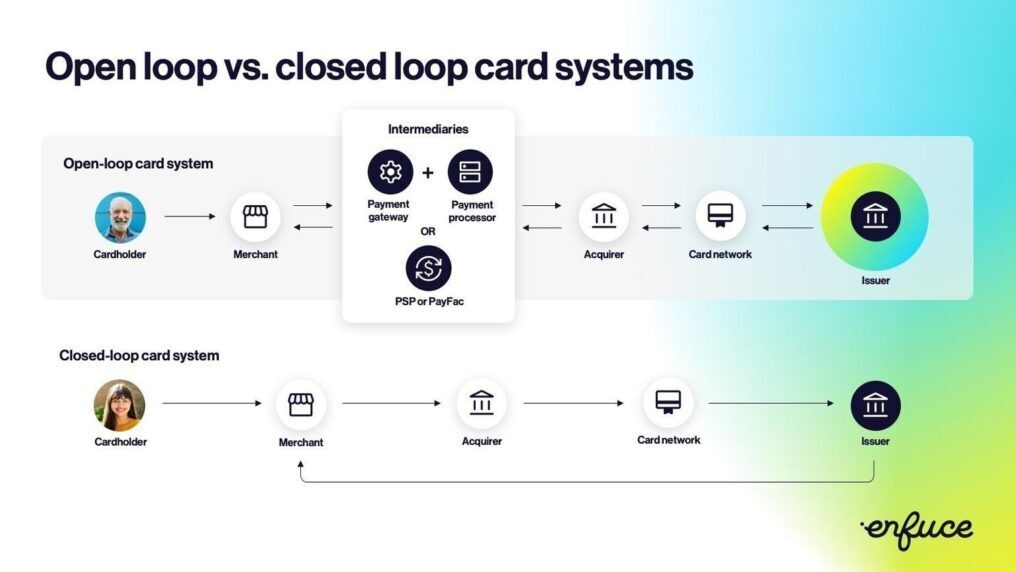
Open-loop is increasingly the direction of travel for many programme launches. Beyond universal acceptance, it aligns with evolving regulations like PSD2 and ECB requirements, and lets programmes adopt new capabilities like tokenisation and digital wallet enablement as they emerge.
That said, closed-loop still fits use cases where pricing control, loyalty economics or network exclusivity matter more than universal reach. The right choice depends on the use case, and modern infrastructure runs both models equally well.
That’s why many companies launching prepaid programs don't do it all themselves. Instead, they partner with an issuing processor like Enfuce for the scheme connectivity, processing infrastructure, and compliance expertise a program needs to run. For companies that don't hold their own licence or scheme membership, that partner can also provide BIN sponsorship, covering regulatory permissions and scheme access under its own umbrella. Either way, it avoids the time, cost, and complexity of building that capability independently.
With that context in mind, here’s how to launch a prepaid card program:
1. Define the business case
Start by identifying the specific problem your card will solve and for whom. Is the goal improving employee benefit flexibility, controlling fleet spend, or issuing prepaid travel cards for employees? And what does the cardholder gain that they can't get from a debit card or credit card? A program built around a clear, differentiated use case is far easier to design, sell, and scale.
2. Set up your processing infrastructure
This is the technology layer that runs your program day to day: authorising transactions in real time, managing account balances, and handling the card lifecycle. Choose an issuing processor that's PCI DSS certified with direct technical connections into Visa's and Mastercard's networks, so you're not left building an authorisation engine and ledger system from scratch.
3. Build in compliance and fraud controls
Open-loop card programs typically require KYC and KYB checks at onboarding, ongoing AML and sanctions screening, and fraud and dispute management processes. These requirements can introduce significant operational complexity, so it's important to have the right processes and partners in place before launch.
4. Configure your account product
A prepaid program runs on an account structure where balances live in the issuing system and are funded via top-ups, bank transfers, including via Faster Payments in the UK, or other approved funding methods. Depending on the program setup, each cardholder account may be assigned its own account number and sort code, enabling direct bank transfers to the card.
During setup, you define rules like whether direct debits or standing orders are supported, how fees are applied (e.g., monthly fees, ATM withdrawal fees), spending limits, and default properties. If the program supports international spending, it's also worth defining any foreign transaction fees and whether inactivity fees apply after a set period of no card use.
These decisions shape the cardholder experience and help ensure the program supports its intended use case, whether that's employee benefits, expense management, budgeting, gift cards, or another application.
5. Design the cardholder experience
Consider how cardholders will interact with the program. How will cardholders manage their accounts, view balances, top up funds, withdraw cash at ATMs, and control their cards, including the ability to request a replacement card if needed? The right combination of apps, digital wallets, authentication methods, card controls and rewards features like cashback can improve adoption and help the program deliver on its intended use case.
6. Secure scheme membership and issue cards
With your processing infrastructure in place and the account structure and controls configured, the next step is securing the scheme membership you need to actually issue cards.
If you don't hold your own licence or Visa/Mastercard membership, this is where a BIN sponsorship model comes in: a licensed issuer like Enfuce provides the scheme access and regulatory permissions needed to issue cards under its BIN, reducing the time, cost, and complexity of obtaining these independently.
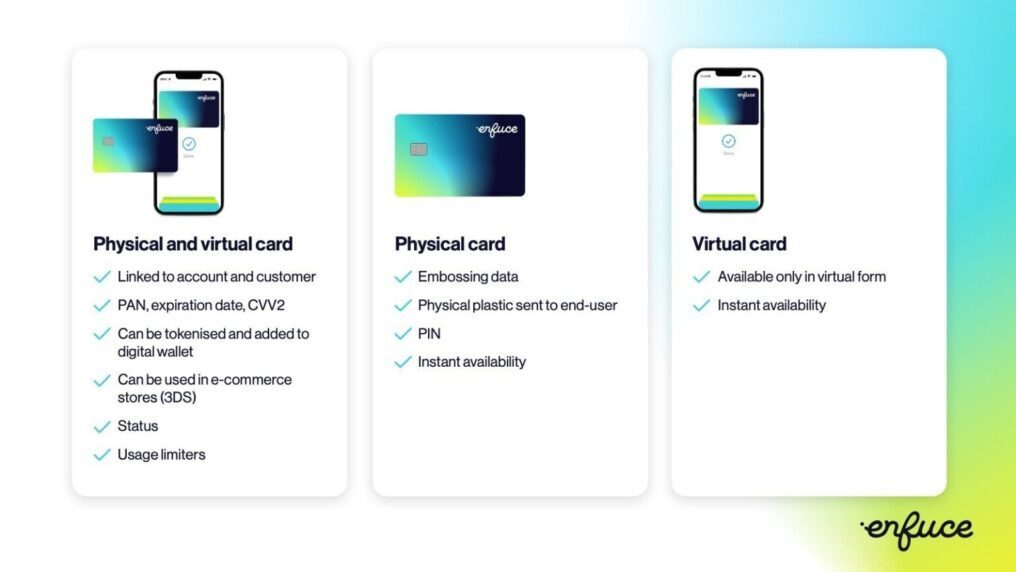
From there, issuing cards to users may involve physical cards, virtual cards, or a combination of both. The choice should reflect how and where cardholders are expected to use the funds.
7. Plan for scale
Launching the program is only the beginning. As cardholder numbers and transaction volumes grow, you'll need processes for customer support, dispute management, card lifecycle management, compliance monitoring, and scheme updates. Choosing the right issuing processor early can make it easier to scale without adding operational complexity.
If card issuing and processing isn’t your core business, these technical decisions, compliance requirements, and operational setup can be overwhelming. The good news is that an issuing processor can handle the majority of this infrastructure, letting you get to market faster without the cost and complexity of doing it all in-house.
What to look for in an issuing processor for prepaid cards
Launching a prepaid card program requires more than card-issuing technology. As discussed above, success depends on two things: building a program with a clear business case and having the operational infrastructure to run it compliantly at scale.
When evaluating issuing processors, focus on whether they can help you address both challenges:
- Program design expertise: The right processor combines the right technology with extensive experience. Look for a partner who can pressure-test your business case, flag where similar programs have struggled, and help you refine your use case. That kind of consultative input early on can save significant time and cost down the line.
- Flexible issuer processor infrastructure: Look for an issuing processor that offers both virtual and physical card issuing. They should support the real-time issuance of virtual cards and digital wallet enablement, as well as oversee the manufacturing, personalisation, and distribution of physical cards. It's also worth confirming they have experience with closed-loop, open-loop, and hybrid programs, so if your strategy evolves, your infrastructure can evolve with it.
- Licensing, compliance, and operational support: If you're not a regulated entity, you'll want a partner that offers BIN sponsorship, covering scheme membership and the necessary EMI licences. Having built-in compliance, fraud management, and dispute handling will also save significant operational overhead and keep you compliant without having to coordinate multiple third-party providers (TPPs). If you're migrating from an existing provider, look for a structured migration process that minimises cardholder disruption.
These capabilities are built into how Enfuce operates. Here's a closer look at what that means in practice.
Why choose Enfuce to power your prepaid card program
Enfuce is a cloud-based API-first card issuing and processing platform with over ten years of experience working with companies across expense management, fleet and mobility, financial services, and employee benefits. We help you serve your end customers directly or enable your own customers to issue cards to their end users, whether consumers or businesses. Built on PCI-certified infrastructure, we offer direct connections to major card schemes including Visa and Mastercard.
For companies that also need BIN sponsorship, Enfuce is a dual-regulated electronic money institution (EMI) authorised by the Financial Conduct Authority (FCA) in the UK and the Finnish Financial Supervisory Authority in the EEA, so we can support your prepaid card program end-to-end.
Here's what you get when you partner with us:
Build a prepaid program around your use case with a flexible issuing processor
Getting a prepaid program right starts with the use case. Enfuce’s solution consultants work closely with you to validate the business case, assess feasibility, and avoid common implementation pitfalls. We’re here to ask the right questions, challenge assumptions, and help you make stronger strategic decisions, just as we did with Pleo.
From there, Enfuce gives you the flexibility to build the program around your specific use case, whether you're launching an employee benefit card, fleet card, or consumer rewards program.
Our platform lets you issue both virtual and physical prepaid cards, including real-time virtual issuing with digital wallet enablement for Apple Pay and Google Pay. For physical cards, Enfuce manages personalisation, manufacturing, and distribution through our MyCard service. We also support phygital programs, which give cardholders the flexibility to move between virtual and physical cards at any point.
You can also co-brand the program with your or your clients’ logo and artwork, and leverage our advanced spend controls to tailor spending restrictions according to your card program’s specific requirements.
Access issuing, processing, and compliance through a single partner
Running a card program involves a layer of compliance and operational infrastructure that sits underneath the cardholder experience.
Compliance, including PCI DSS certification and PSD2 compliance, is built into Enfuce’s platform, with continuous updates to meet requirements from both regulators and card schemes. Fraud and dispute management are available as optional add-on services.
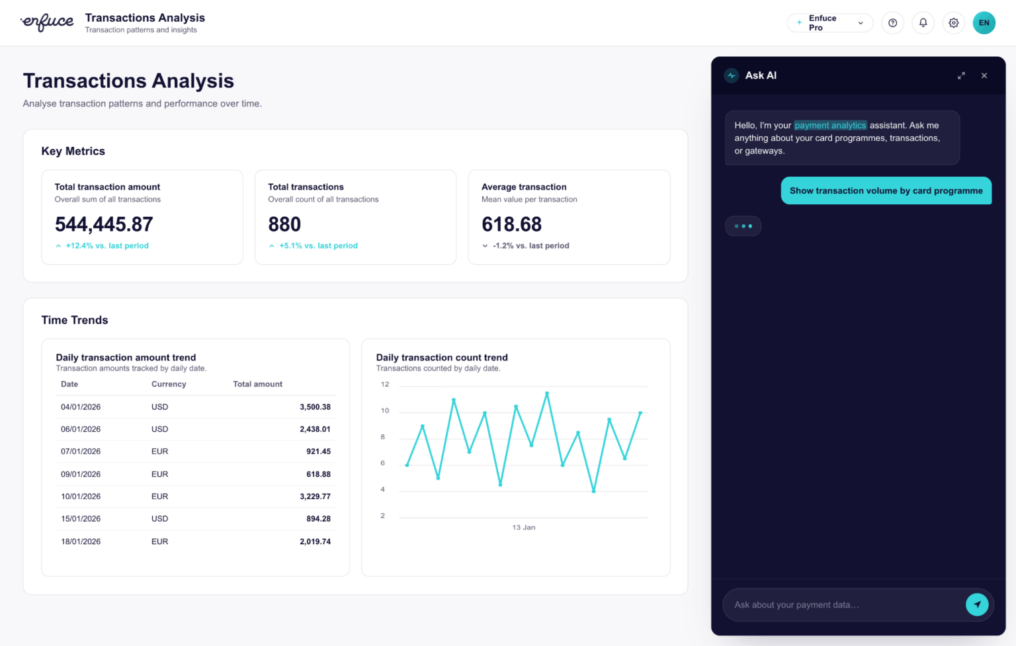
Additionally, you get access to embedded analytics, which gives you a single source of truth on program performance, like transaction activity, spending patterns, and card usage. And because all of these capabilities are part of Enfuce’s modular platform, they can be integrated as needed without requiring you to source and manage multiple external providers.
If you don't hold your own licences or scheme membership, you can issue cards under Enfuce's BIN sponsorship, which gives you scheme access with Visa and Mastercard and the EMI licensing needed to operate in the UK and Europe. As a dual-regulated EMI, Enfuce can safeguard customer funds on your behalf.
Scale open-loop, closed-loop, and hybrid program models
Different prepaid card programs have different requirements. Some are designed for use within a specific merchant ecosystem, while others prioritise broad acceptance through Visa or Mastercard. In some cases, organisations may even take a hybrid approach that combines open-loop acceptance with tailored spending controls.
As your program grows and your use case matures, the program model that makes the most sense may change. What started as a closed-loop model might eventually call for open-loop acceptance, or an open-loop program might need spending restrictions layered in over time.
These changes introduce new operational and compliance considerations, including PSD2 obligations, KYC and KYB requirements, AML and sanctions screening, and scaled fraud and dispute management. That’s why you want an issuing processor that can support you through each transition.
Enfuce supports open-loop, closed-loop, and hybrid programs, so you don't need a different partner as your strategy evolves. Our team can help you understand what each model involves and how to manage the transition correctly.
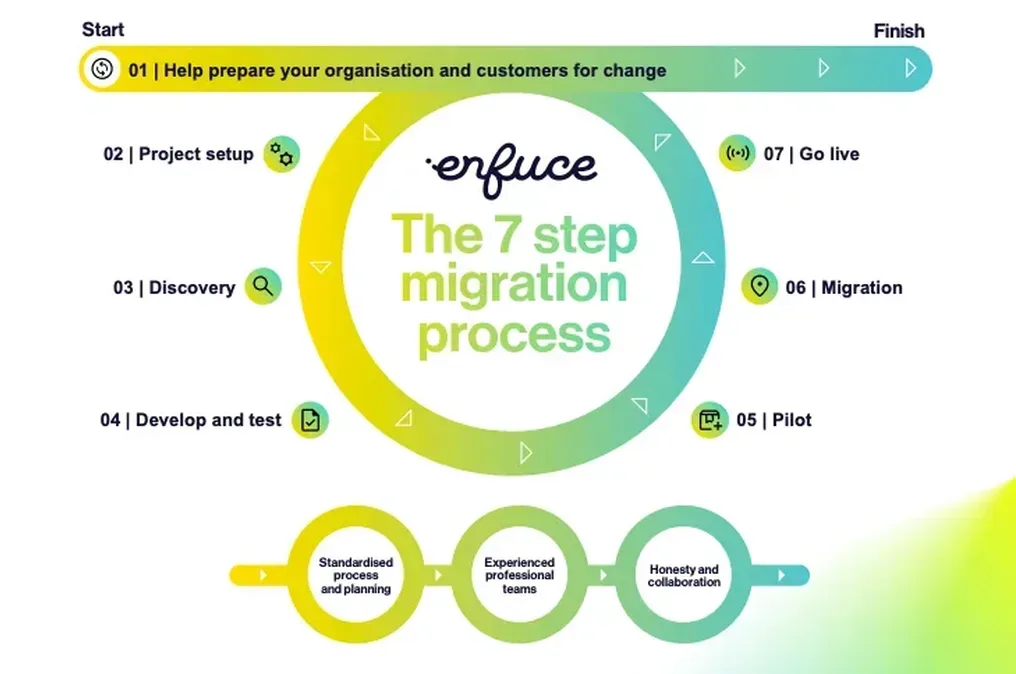
Plus, our proven seven-step migration process is designed to keep any disruption invisible to cardholders. For instance, when YAY launched Iceland's first open-loop virtual gift card with Enfuce, the program retained merchant whitelisting controls through an authorisation control feature, giving recipients more flexibility than a traditional closed-loop card while keeping the program manageable for YAY.
How Monizze upgraded to an open-loop prepaid employee benefit program
Transitioning from a closed-loop model to open-loop is often one of the more complex changes a prepaid program can undergo. But when it's the right call for the use case, the payoff for cardholders is significant.
Seeking a more flexible card model, Monizze sought to switch its employee benefit cards to an open-loop model while preserving the controls required for benefit-specific spending. It partnered with Enfuce to launch open-loop employee benefit cards in Luxembourg and hybrid closed- and open-loop employee benefit cards in Belgium.
As with any large-scale card program migration, success depended on careful planning and execution. Enfuce supported the transition through our structured seven-step migration framework, designed to minimise disruption for cardholders and operational teams while maintaining continuity throughout the process.
Sébastien Couturiaux, CTIO of Monizze, described the partnership: “We chose Enfuce for their proven ability to deliver large-scale open-loop migrations with speed, precision and reliability. Their deep expertise in the employee benefits space, demonstrated through successful partnerships, gave us full confidence in their ability to support our ambitions.”
Powered by Enfuce, Monizze’s upgraded cards bring real-time spend controls, fraud protection, and digital wallet support to their employee benefit offering. The move to open-loop means Monizze can now bring any merchant into their benefits network, significantly widening the pool of places employees can spend. For cardholders, that translates to genuine flexibility, with benefits that work across a broad merchant network, in-store and online.
Learn more about Monizze’s prepaid card program here.
Get your prepaid card program to market faster with Enfuce
Launching a prepaid card program involves more than issuing cards. You need the right business case, compliant infrastructure, reliable processing, and a setup that can evolve as your program grows. That’s a significant undertaking if card issuing isn’t your core business.
Enfuce helps remove that complexity. With ten years of experience in card issuing and processing, built-in compliance infrastructure, and support for closed-loop, open-loop, and hybrid programs, we provide what you need to launch, run, and scale a prepaid card program, without the overhead of building and maintaining the infrastructure yourself.
Contact us to launch your prepaid card program.
Let's talkFAQs on prepaid card program
What is a prepaid card program?
A prepaid card program involves cards where funds are loaded in advance, with no bank account or credit line attached. Cards can be closed-loop (restricted to specific merchants) or open-loop (accepted anywhere on major card networks). Open-loop programs require an EMI or banking licence, as well as scheme membership, either held directly or through a BIN sponsor.
Can I offer both physical and virtual prepaid cards?
Yes. Many prepaid card programs offer both physical and virtual cards so cardholders can choose how they pay. You can even opt for a phygital approach, which lets cardholders switch between the two at any point, even after onboarding.
What industries commonly use prepaid card programs?
Prepaid card programs are widely used across employee benefits, expense management, fleet and mobility, fintech, travel, and retail gift cards. They’re especially useful when businesses need controlled fund distribution, spend visibility, or a flexible alternative to cash reimbursement processes.
Does a prepaid card offer Section 75 protection in the UK?
No. Section 75 protection applies to credit card purchases between £100 and £30,000. Prepaid cards aren't credit products, so this protection doesn't apply. Program operators should factor this into cardholder communications, particularly if positioning prepaid as a flexible alternative to credit.
Are prepaid card balances protected by the FSCS?
No. The FSCS (Financial Services Compensation Scheme) deposit protection applies to bank and building society deposits, not e-money or prepaid card balances. However, regulated electronic money institutions like Enfuce are required to safeguard customer funds, typically by holding them in segregated accounts, kept separate from the EMI's own operating funds. In the event of insolvency, safeguarded funds are returned to customers ahead of other creditors.
Interested to explore more? Let’s talk
Enfuce is a global card issuing payment processor built for banks and mid-to-enterprise-level fintechs, lenders, and fleet and mobility providers looking to scale existing card programmes or launch new ones.

