From feature to core layer: Why hybrid fleet payments require a new infrastructure
Hybrid fleets are exposing the limits of legacy fuel card setups. Hybrid fleet card programmes can’t be bolted on, but must unify fuel, EV charging, and wider mobility spend.
With electric cars making up 20% of all new registrations in 2025, and electric vans sitting at 25% of new light commercial vehicle registrations, it’s safe to say fleet composition is undergoing a structural shift.
Yet fleet payments haven’t kept pace. Most businesses still depend on the same setup they used back when electric vehicles were science fiction.
The driver gets a fuel card that’s tied to a specific network and is limited to fuel and, perhaps, a handful of associated expenses – maybe maintenance products, car wash, and, possibly, snacks for the road.
Finance, meanwhile, have to chase receipts, reconcile invoices from multiple suppliers, and carry out other time-consuming manual admin.
To date, most businesses have adapted by layering EV payments onto legacy systems. But with increasingly ambitious CO₂-reduction targets, growing regulatory pressure, and cross-border operations becoming standard, this approach is reaching its limits.
As hybrid fleets become the norm, EVs can no longer be treated as an add-on. They need to be embedded at the core of fleet payments infrastructure, enabling a single, unified layer across fuel, EV charging, and the full spectrum of mobility spend.
Why cards are just the tip of the iceberg
Because cards are the one element of the fleet payment lifecycle everyone interacts with – fuel brands, fleet operators, charging networks, mobility platforms, fintechs and software providers, drivers, fleet managers, and finance teams – it’s easy to blame them when something breaks.
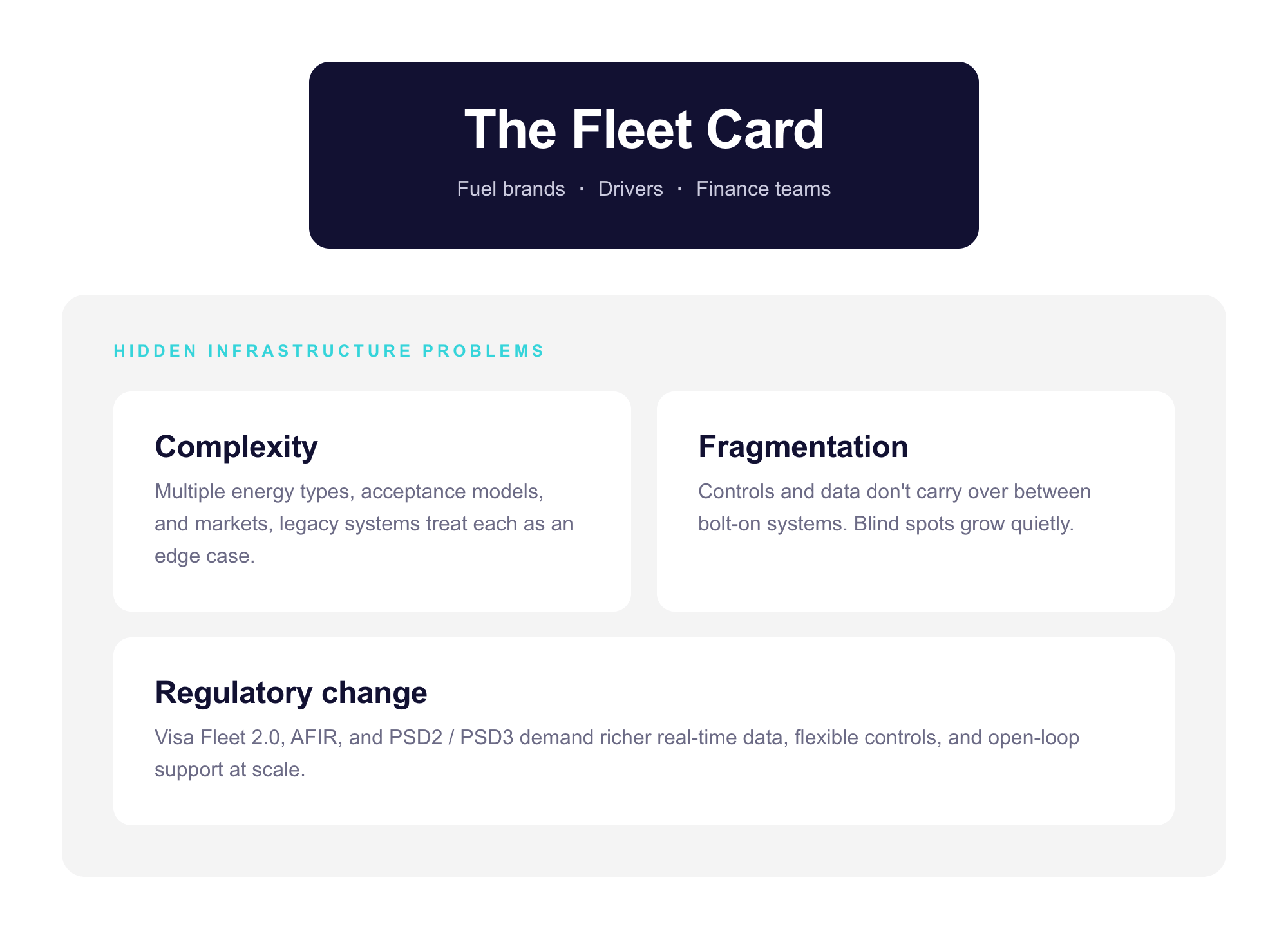
But the real issues sit in the infrastructure behind them:
- Complexity
- Fragmentation
- Regulatory change
None of these are problems you can solve with ‘a better card’ or by adding EV as an additional merchant category. The underlying conditions must change to reflect how hybrid fleets work, with unified controls, structured data, real-time authorisation, and support for both open-loop and closed-loop models.
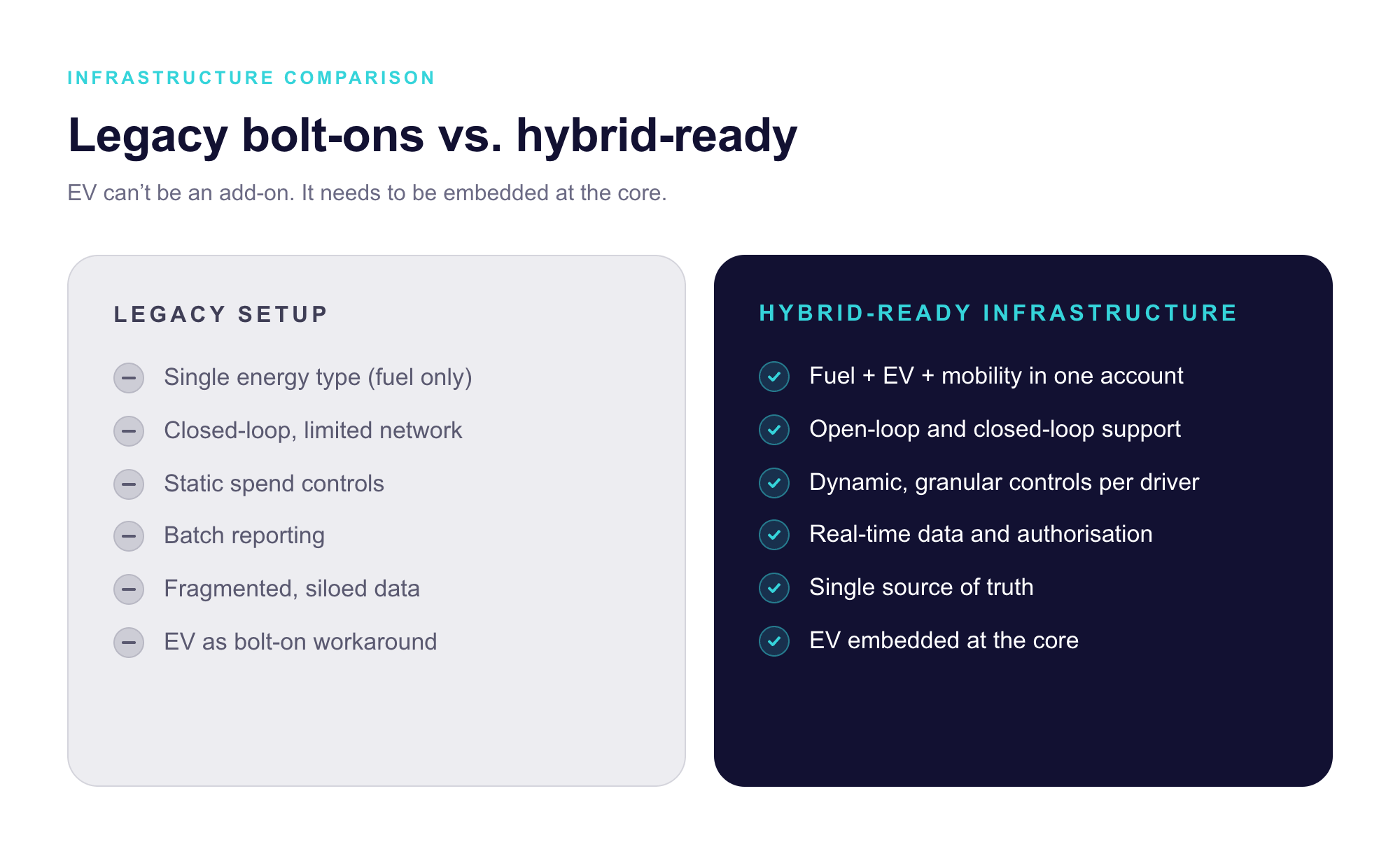
Complexity
Legacy fleet payments were designed for a simpler world: one dominant energy type (petrol or diesel), relatively stable acceptance networks, static spend controls, and batch reporting.
Hybrid fleets don’t work like that. They need support for multiple energy types, acceptance models – that is, closed loop, open loop, and third-party services – and markets within one unified system.
In the latter scenario, mobility becomes a much bigger category than simply petrol or diesel, car wash, and a few on-site extras. It also includes wider travel expenses like tolls, parking and, perhaps, even overnight accommodation.
When infrastructure treats hybrid fleets as an edge case, every new requirement becomes another workaround. Each new bolt-on adds configuration layers and exceptions, so you need more manual effort just to keep things running.
Over time, reporting fragments across disparate systems, controls become inconsistent, and workflows are duplicated. And, because the effect is cumulative, not instant, things often seem fine until the amount of manual intervention required reaches unsustainable levels, or the available data is incomplete or too fragmented to support confident decision-making.
Fragmentation
Alongside operational complexity, hybrid-era legacy bolt-ons introduce a more fundamental issue: they’re not typically designed to work together seamlessly across different controls, data, and reporting flows.
Specific controls may not carry over smoothly from one system to another. The same goes for transaction data. Different systems may send it at different times, in differing formats, with varying levels of detail.
The consequent impaired visibility makes it more difficult to answer basic questions like ‘What are we spending and where?’ and to make clear-eyed operational decisions.It’s even more challenging to apply spend controls consistently and detect and prevent fraud. The latter issue is especially pressing because, according to a 2022 survey, fleet operators lose up to 5% of their fuel budgets to fraud.
Regulatory change
Visa’s Fleet 2.0 has significantly raised the bar in ways which legacy systems can struggle to cope with at scale.
Controls at authorisation need to be more flexible than the rigid, pre-set rules backed by batch reporting that legacy fuel cards typically use.
Transaction data also needs to be richer – requirements include vehicle and driver ID, line-item detail, and category-level tagging – and available in real-time, so fleets can enforce policies and analyse spend when it matters.
Change has also come at EU level.
The Alternative Fuels Infrastructure Regulation(AFIR) has a strong focus on making payments at public charging points more accessible and interoperable, including support for open-loop card acceptance alongside appropriate dispute settlement mechanisms and compliance processes
Meanwhile, the EBA has indicated that, under certain conditions, and depending on how a specific fleet payments programme is structured and scoped, fuel cards can be considered payment instruments under PSD2. The upcoming PSD3 is also expected to tighten the criteria for closed-loop and limited-network exemptions, so that more complex, multi-fuel and cross-border fleet models have less leeway to rely on these interpretations.
Many of these changes formalise what the market was already moving towards. This makes it even clearer that legacy workarounds are no longer viable at scale.
The way forward: one account, one card, end-to-end visibility across fuel, EV charging, and mobility spend.
Given the differences between traditional and hybrid fleets, it’s fair to worry that your infrastructure might need a radical overhaul. But, even where wholesale change is required, the shift is more about approach than shock therapy.
The ultimate goal is a scheme-agnostic, regulation-ready platform. One that supports mixed-energy fleets, real-time visibility, and effective controls, and has compliance built-in. Just as important, it should have partner-ready architecture and have enough flexibility to easily adapt to future changes.
Some organisations may choose to move towards this goal in stages, with legacy and hybrid-ready infrastructure running in parallel before converging.
Others may choose to execute a cleaner platform cutover. Here, a solution like Enfuce can minimise disruption and keep the customer-facing offering stable by continuing to support existing card products while adding new ones alongside them on a modern stack.
But what does hybrid fleet-ready infrastructure look like in practice?
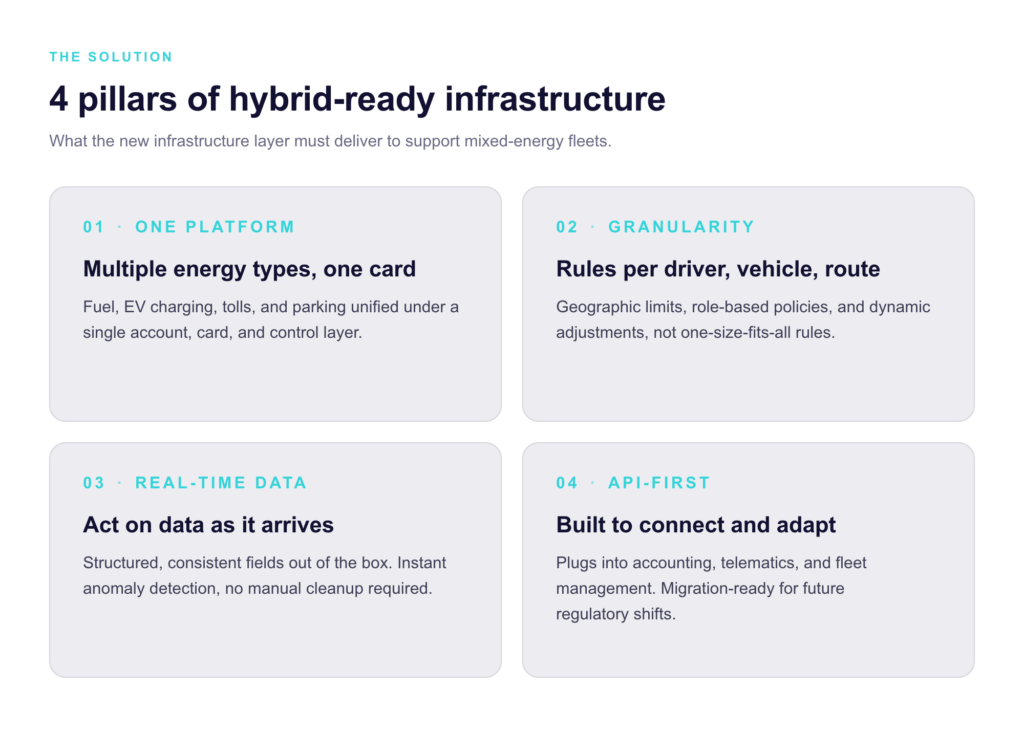
One platform, multiple options.
Hybrid-ready infrastructure should provide a single, consistent way to manage mobility. One card and account to fill up, charge an EV, and pay tolls, parking, and other related expenses, and a single shared layer of controls, data, and reporting across these different spend categories.
Just as important, it should support both open-loop and closed-loop logic. This means drivers aren’t forced to take lengthy, inefficient detours when they need to refuel, charge, or take a break, while issuers can offer broader acceptance with consistent controls, which improves the customer experience and, in turn, boosts loyalty.
A unified system is easier for everyone. Drivers don’t have to switch between several cards, and can rely on a single, consistent way to pay for fuel, EV charging, and mobility. And finance teams and decision-makers replace fragmented data and parallel workflows with a single source of truth.
Greater granularity.
The assumption that one rule suits everyone simply doesn’t work for hybrid fleets.
When drivers might use a petrol car one day and an EV the next – and some drive exclusively within a single region while others cover multiple markets – you need more advanced controls:
- Geographic limits that reflect the actual routes drivers use, not a single ‘typical’ pattern
- Different rules for different vehicles and drivers, depending on their role, seniority, and risk profile
- Dynamic adjustments tailored to driver behaviour and usage patterns over time
These are exactly the kinds of capabilities that a unified fleet payments infrastructure layer like Enfuce’s is meant to support: one governed system applying consistent rules and data across fuel, EV charging, and wider mobility spend, in place of a patchwork of bolt‑on products.
Real-time data filtering.
True visibility is a two-fold process.
You need instant access to data, of course. But, critically, hybrid-ready infrastructure must also make it easy to act on that data straight away.
In practice, this means data must arrive in a state that allows you to use it out of the box. That is, with consistent structure and fields. Having to clean up, organise, and prepare data beforehand defeats the purpose.
Hybrid-ready infrastructure should also provide filters, alerts, and other capabilities that can quickly surface anomalies like unusual refuelling patterns, odd route choices, and spending on categories that are outside your travel expense policy.
This is why Enfuce incorporates dynamic spend controls and transaction settlement, empowering platforms, operators, and card issuers to proactively prevent issues instead of having to engage in continuous firefighting.
API-first architecture.
How easily can fleet payment capabilities connect to the wider ecosystem?
Data accuracy and effective oversight ultimately depend on the payment layer’s ability to seamlessly slot into and communicate securely with accounting systems, fleet management software, telematics, and other modern technologies.
More to the point, with regulations trending toward more limited closed-loop exclusions, hybrid-ready infrastructure should keep your options open, enabling you to choose between building your own regulated payment infrastructure or partnering with a licensed third party.
Enfuce’s platform is designed with this flexibility in mind. It supports both open-loop and closed-loop programmes on a single platform, and its modular, API-first architecture is migration-ready while also enabling you to build hybrid-ready infrastructure without starting from scratch.
Change is inevitable. Disruption is optional.
100% electric fleets may be unlikely in the short term, but the traditional fossil fuel-only model is undoubtedly a thing of the past.
Globally, commercial fleets are aiming for at least one in four vehicles to be electric by 2030. In the EU, more aggressive targets could nudge electric car sales to over 50% of all new registrations overall.
The bottom line is that hybrid-ready payments infrastructure is a strategic imperative. Whether you’re a fleet operator, card issuer, mobility platform, or service provider, the time to embed it into your systems is now. Even if your processes still look ‘fine’. Otherwise, the risk is that, rather than redesigning your fleet payments platform on your terms, you’ll have to react when it breaks under the strain.
A staged migration with legacy and hybrid fleet payments-ready systems running in parallel is the safest way forward, because it enables you to upgrade the issuing and processing infrastructure beneath your existing programme without noticeable disruption.
Want a more in-depth look at what should change so payments architecture can better support hybrid fleets now and in the future?Download our Hybrid Fleet Payments Playbook