Fuel card programme issuing: A guide to business expansion
If you’re exploring fuel card programme issuing, you might be:
- New to fuel cards and looking to expand into the fleet and mobility space to better serve your mobility-heavy customers
- A traditional fleet or fuel card issuer feeling the constraints of your current programme as customers demand broader acceptance, new use cases, and international reach
Fuel card issuing comes with unique technical, operational, and regulatory considerations not every issuer processor can handle. Unlike general B2B card issuing, fuel card programmes often need granular merchant and product controls (e.g., limiting spend to diesel at specific stations), support for hybrid fuel + EV charging journeys, and cross-border fleet usage at scale. They also come with additional requirements around tax handling, invoicing, and reconciliation that many issuing stacks don’t support out of the box.
So, before you start building or upgrading your fuel card programme, it’s important to understand what you need to create a scalable, future-ready product – not one that quickly hits its limits. That’s why, as experts in card issuing and processing, we’re covering the core steps to begin issuing fuel cards, as well as what to look for in a fuel card issuer processor.
In this guide:
- How to issue fuel cards: 8 core steps
- What to look for in a card issuer processor for your fuel card
- Why choose Enfuce to issue and process your fuel card programme
- How Enfuce helped Octopus Electroverse build a future-ready payment card
- FAQs about fuel card programme issuing
Ready to launch or scale your fuel card programme? Enfuce provides the issuing expertise and technology to make it happen. Contact us today.
How to issue fuel cards: 8 core steps
While our fuel card issuer’s guide covers everything you need to know about launching or upgrading a fuel card programme, here’s a quick overview to help you start on the right foot and see how fuel cards work:
- Clarify the programme’s purpose and value: Today’s fleet and mobility programmes often go beyond fuel, covering EV charging, tolls, parking, and other expenses at fuel stations. For new issuers, outline what you want to offer customers. For existing issuers, identify opportunities to expand or enhance your current programme.
- Design your fuel card programme: Choose the card form – physical, virtual, tokenised, or wearables – and define your acceptance model and where it should work (e.g., closed-loop, open-loop, or hybrid; domestic vs cross-border; fuel-only vs broader mobility like EV charging, tolls, and parking). Then configure core programme settings, such as fee structures, multi-currency, spending and usage restrictions (by merchant, merchant category, product type, time, and limits), security rules, and compliance obligations.
- Decide whether to build, buy, or partner: You can build a solution in-house, buy a turnkey platform, or partner with an experienced issuer processor.
- Establish project foundations: Set up a cross-functional team, define the to-be solution (target architecture, integrations, operating model), and lock timelines and deliverables. Secure enablers like BIN sponsorship and licences. For migrations, plan the move in detail (data mapping, cutover strategy, phased portfolio migration). You remain responsible for retailer agreements, legal obligations, and tax requirements, such as His Majesty’s Revenue and Customs (HMRC) obligations in the UK.
- Implement and validate: Configure your card product, build the necessary integrations, and run end-to-end functional and security testing. Double-check vendor reliability, compliance, and operational workflows.
- Pilot the programme: Test with a limited group of users. Validate onboarding processes, authorisation flows, and support workflows to catch and fix issues before full-scale launch.
- Launch: Go live once all operational and customer-facing teams are aligned and prepared to handle high-volume inquiries.
- Optimise and future-proof: Monitor key metrics like activation rates, approval rates, and transaction volumes alongside fuel costs. Act on feedback to resolve issues and enhance features as fuel prices shift. Stay innovation-ready by adopting emerging payment methods or mobility solutions.
Handling these steps yourself is possible, but partnering with a card issuer processor is often easier. You get the speed of a turnkey solution, with the flexibility to tailor your programme as if built in-house.
What to look for in a card issuer processor for your fuel card
Choosing the right card issuer processor can make or break a fuel card programme. Here’s what to prioritise:
1. Expertise and fuel-specific features
Closed-loop systems remain valuable, but fleet and mobility programmes increasingly require open-loop or hybrid card solutions to meet geographic, customer, and regulatory expectations, such as the EU’s AFIR requiring open-loop payment acceptance (alongside other payment methods) at public EV charging stations.
The right issuer processor brings both fuel-specific expertise and operational flexibility. Advanced spend controls – by merchant category, individual merchant, or product type, like diesel or other types of fuel – are common in closed-loop fuel card programmes but harder to implement in open-loop.
Look for a provider that can support both systems and embed rules and controls into open-loop or hybrid programmes so they function like a closed-loop programme where it matters.
2. Speed to market and migration capability
Look for a partner that can help accelerate your time-to-market. A provider that offers BIN sponsorship and access to scheme networks can reduce regulatory hurdles and shorten how long it takes to launch your programme or expand into new markets.
Meanwhile, sandbox environments and well-documented APIs enable iterative development and early testing, helping your team quickly validate new features and fine-tune functionality before full launch.
Ideally, your provider can easily integrate its solution with your existing core banking and CRM systems. An API-first card issuing approach is often the most flexible and efficient way to achieve this.
Migration often becomes necessary when moving from fuel-only or closed-loop models to hybrid or open-loop acceptance (e.g., combining fuel, EV charging, and broader mobility spend). For existing fleet card programmes, look for an issuer processor with a proven, low-risk migration framework – ideally one that permits portfolio-by-portfolio flexibility when switching processors.
3. Real-time operational control
Cloud-native, API-first platforms put control in your hands by removing day-to-day dependence on vendor support. Your teams can manage cards, monitor transactions, and adjust repayment logic themselves. This enables faster programme updates, quicker issue resolution, and smoother daily operations.
4. Easy access to real-time data and insights
Look for systems that provide instant, transaction-level data access to support expense tracking. Dashboards visualising fraud, chargebacks, and blocked transactions can help with proactive card management, while tools for customer segmentation and category spend analysis including fuel spend and fuel consumption are powerful for identifying trends and tailoring offerings to enhance the customer experience.
Whether you’re a new entrant or expanding your card offerings, centralised, easy-to-access insights help your team track performance, manage risk, keep an audit trail and identify opportunities to improve the programme.
5. Built-in compliance and fraud handling
Ideally, your processor is regulated in the markets you’re expanding into (e.g., from the UK into the EU or vice versa) and offers direct authorisation. This reduces reliance on third parties and gives you confidence that your partner understands regulatory requirements across jurisdictions.
Additionally, look for a platform where compliance is embedded – not bolted on – with standards like PSD2, AML, PCI DSS, GDPR, and scheme rules built directly into workflows, templates, and rule engines.
Proactive fraud prevention is also essential to protect revenue and avoid operational disruption. Platforms with advanced fraud rule engines – supporting segment-specific rules, real-time alerts, and automated blocking – empower you to contain risk quickly without stopping legitimate spend.
6. Modularity and reliability
It helps to work with a partner that offers a modular architecture, enabling you to launch with the capabilities you need today and add features, regions, or product types as your programme evolves. Consider, too, how that flexibility extends into how you structure and operate your programme:
- Does the platform offer support for debit, prepaid, charge, and credit cards across open and closed networks, for both B2B fleet programmes and B2C mobility use cases? Having one unified system that can support different kinds of card programmes helps avoid silos, simplifies reporting, and ensures consistency across products, markets, and user experiences.
- Does the provider support both full-service and in-house models? This will give you control over how much to outsource and how much to manage internally as your strategy evolves.
The platform also needs to be able to handle traffic spikes – such as payroll days or holiday peaks – without degradation or downtime. And beyond the technology itself, look for partners that offer enterprise-level SLAs, with service guarantees in place for uptime, fraud response, scheme changes, and dispute support.
7. Scalability across borders
Cross-border readiness is particularly important for fleet management and mobility programmes, where cards are often used across regions. Look for an issuer processor that supports multi-country, multi-currency programmes with built-in localisation, compliance logic, and scheme alignment. True scalability means both new and established programmes can grow alongside evolving customer needs and market opportunities.
Why choose Enfuce to issue and process your fuel card programme
Enfuce is a Europe-based card issuer processor, with offices in Espoo, Mariehamn, and London, serving businesses across the UK, Europe and South America.
With over a decade of experience and a team of 150+ experts, we help companies stay ahead with secure, scalable, and future-proof card solutions. We handle every aspect of issuing and processing, and our modular, API-first platform lets you build exactly what you need. When it comes to fuel card programme issuing, we help:
- Mobility-heavy corporate teams: Companies with teams frequently on the road – sales forces, field service technicians, maintenance crews – that need payment solutions that work across regions and small businesses. Expense management firms serving those high-mobility clients would also benefit from offering a fuel card.
- Specialised fuel card providers expanding across borders: Providers already issuing fuel cards for commercial vehicles, trucks, or fleets that are looking to offer pan-European coverage to better serve cross-border clients.
- Fleet and mobility providers upgrading their card programmes: Fleet operators that want to move from closed-loop to open-loop or hybrid cards to support EVs and diverse fleets while retaining granular spend controls, real-time monitoring, and detailed reporting.
Here’s what you can expect when you partner with us:
1. Fuel card expertise backed by hands-on support
Fleet and mobility programmes come with unique requirements, from advanced spend controls to specific regulations, and without the right expertise, it’s easy to get bogged down in operational, technical, or compliance challenges.
With Enfuce, you stay in control of your programme – including retailer agreements, legal, and tax requirements – while we power the card issuing and processing engine.
As early adopters in the fleet and mobility space – for example, as the first Visa Fleet 2.0-certified issuer processor in Europe – we know what works and can help you avoid common pitfalls. Our team of experts provide hands-on support to ensure you’re building solid business cases and making the most of our API.
You’re also supported by our structured seven-step migration framework, which aligns all relevant departments – operations, risk, finance, marketing, customer service, and legal – to ensure a smooth, low-risk transition.
On top of that, our API-first, modular platform lets you pay only for what you use. That flexibility is ideal whether you’re a new entrant launching without extra features or an established issuer scaling up. Start with the capabilities you need today, then layer on additional features as your strategy evolves.
2. Fleet-specific payment controls built for fuel, EV, and more
Legacy issuer processors built for banks and general-purpose cards often struggle with the realities of fleet and mobility programmes. Fuel- and EV-related payments come with unique requirements – granular controls, real-time decisioning, and regulatory guardrails – legacy systems weren’t designed to handle.
Enfuce supports closed-loop, open-loop, and hybrid card programmes, giving you the flexibility to expand merchant acceptance or tighten controls as needed – without having to change providers. This ensures your programme can evolve with your strategy over time.
Enfuce’s fleet and mobility payment capabilities are purpose-built to support both today’s fuel use and the transition to electric and multimodal mobility. With a single, universally accepted card, you can support fuel expenses, EV charging, and other mobility-related expenses – removing the need for separate solutions as fleets evolve.
Control is a central part of that experience. Enfuce supports advanced spend controls that let you define where cards can be used, how, when, and for what purpose when drivers fill up. Spend controls can be set at both product and individual card levels, updated in real time via the Card API, and adjusted as needs change to reduce misuse without slowing down legitimate transactions.
These features enable you to create truly bespoke card programmes that differentiate you from the competition and strengthen customer loyalty.
3. Embedded compliance and fraud prevention that scales across borders
Expanding a fuel or mobility card programme across borders adds complexity as different regulatory requirements and fraud risks come into play. Enfuce removes much of that burden by embedding compliance and fraud handling directly into the platform.
With Enfuce, you get built-in support for key European requirements, including PSD2, Strong Customer Authentication (SCA), and EU Cross-Border Payment regulation (CBPR). As a regulated card payment processor, we’re assessed annually and certified for PCI DSS Level 1 and PCI 3DS. Plus, all cards are enrolled in 3D Secure by default, adding an extra layer of protection for online transactions.
When it comes to fraud prevention, Enfuce provides 24/7 monitoring using advanced behavioural analytics that adapt to portfolio-specific spending patterns. This enables you to quickly identify genuine threats – such as unauthorised purchases and data breaches – while reducing false positives that can disrupt legitimate transactions.
Enfuce also supports compromised card handling, card replacements, chargebacks, and dispute management in line with scheme and regulatory requirements.
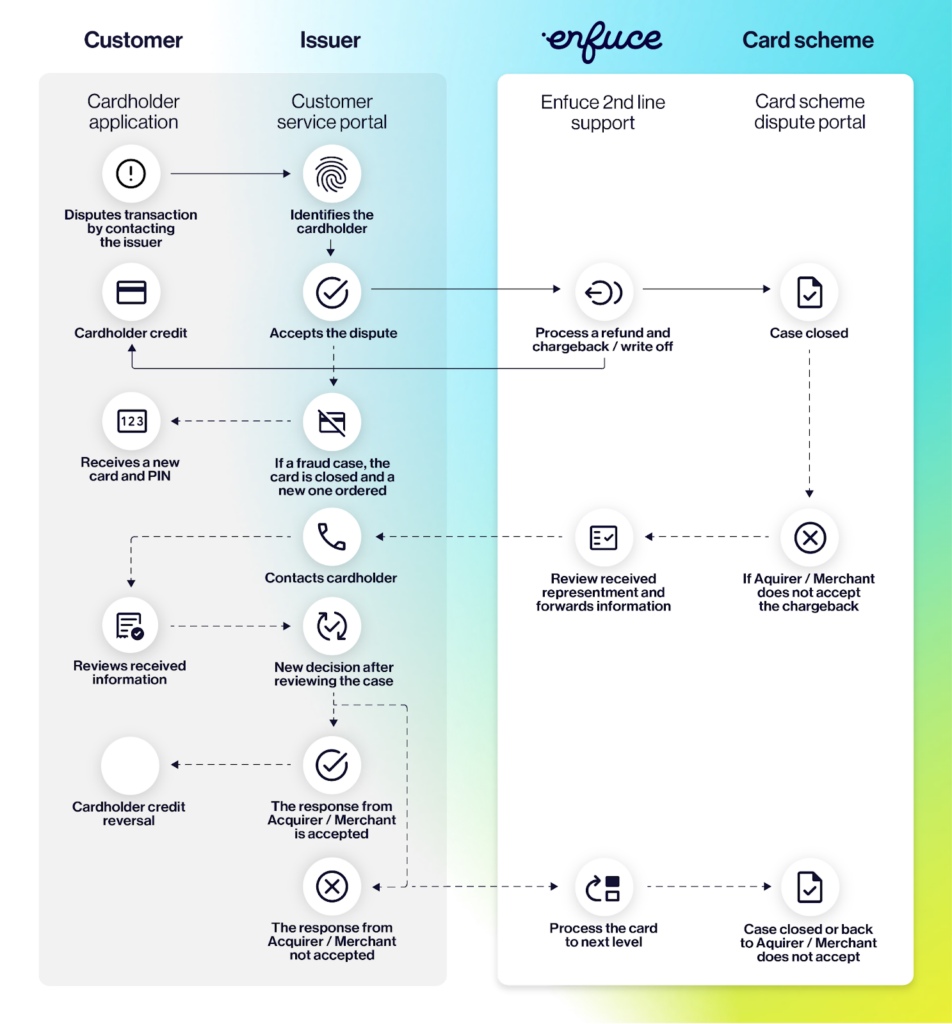
With compliance and fraud controls built in, your programme can expand across regions and volumes without needing to revisit regulatory or fraud obligations at every step.
How Enfuce helped Octopus Electroverse build a future-ready payment card
Octopus Energy’s Electroverse – Europe’s largest EV charging network – connects drivers to over 960,000 chargers through a massive network of operator brands in over 40 countries. When they set out to create a smart business payment card for fleets, their goal was ambitious: a single fuel card that could handle everything from EV charging and fuel to everyday operational expenses.
To make that vision a reality, they partnered with Enfuce for card issuing, BIN sponsorship, and regulatory expertise across the UK and Europe. Our cloud-native, modular platform powers the Electroverse Business Payments Card – an open-loop Visa Fleet 2.0 solution that combines advanced real-time spend controls, instant transaction monitoring, built-in compliance, and robust fraud protection.
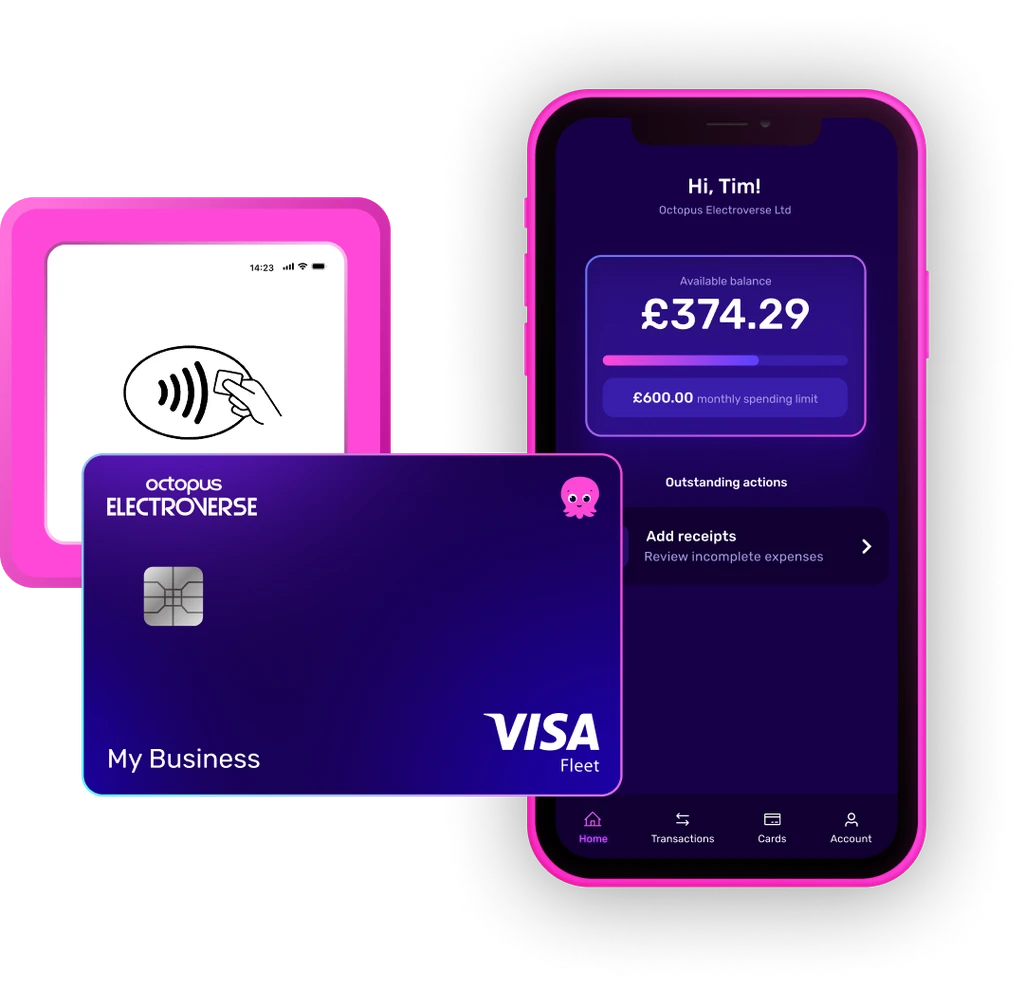
Matt Pretorius, Head of Fleet Solutions at Octopus Electroverse, described the collaboration: “With a strong partner handling the complex work in the background, from BIN sponsorship to regulatory support, we were able to remain the masters of our own destiny. Bringing those strengths together in a true partnership is what has led us to where we are today.”
By bringing together Octopus Energy’s EV expertise with Enfuce’s flexible, cloud-native platform, the Electroverse Business Payments Card gives fleets the visibility and control they need today, with the adaptability to scale and evolve as mobility needs change.
Learn more about how Enfuce and Octopus Electroverse are working together to power the future of electric mobility.
Issue a fuel card programme that’s compliant, scalable, and future-proof
Done right, launching a fuel card programme can strengthen customer relationships and unlock new revenue streams and cost savings. But success depends on getting the foundations right, from fleet-specific features to regulatory compliance and scalable infrastructure for fuel management.
Whether you’re entering the fleet and mobility space for the first time or upgrading an existing programme, partnering with an experienced issuer processor like Enfuce helps reduce risk, accelerate time to market, and ensure your product is future-ready.
Get in touch with us to launch or scale your fleet card programme.
FAQs about fuel card programme issuing
What is fuel card programme issuing?
Fuel card programme issuing is the process of creating and managing payment cards designed specifically for fuel purchases, EV charging, and other fleet-related expenses. These programmes are designed to give businesses control over spending, enable real-time transaction monitoring, and simplify expense management for fleets to streamline operations.
How do you issue fuel cards?
Issuing fuel cards involves designing the card programme, choosing card types, configuring fees, rules, and compliance measures, and (if you’re issuing open-loop) integrating with payment networks like Visa or Mastercard. You can build a full-stack card issuing platform in-house, buy a turnkey solution, or partner with an experienced issuer processor.
Why partner with an issuer processor to build a fuel card programme?
Partnering with an issuer processor combines the speed of a turnkey solution with the adaptability of a custom build. For example, Enfuce provides the infrastructure, compliance, and operational services you need to launch a fuel card programme without building it all yourself. This lets you focus on designing a great customer experience, creating innovative card products, and growing your business – while leaving the complex technical, regulatory, and operational work to us.