MySeatAtTheTable – Making space for better decisions.
At Enfuce, diversity is not a seasonal message. It shapes how we lead, how we grow, and how we create lasting impact. As a female-founded and female-led company, we believe progress happens when people are trusted with influence and encouraged to use it.
Now in its third year (!), My Seat at the Table continues as a space for honest conversations and real stories. What began as a reflection for International Women’s Day has evolved into an ongoing commitment to amplifying voices and redefining leadership on our own terms.
Through this series, we spotlight the women across Enfuce who are shaping fintech, challenging expectations, and opening doors for others along the way.
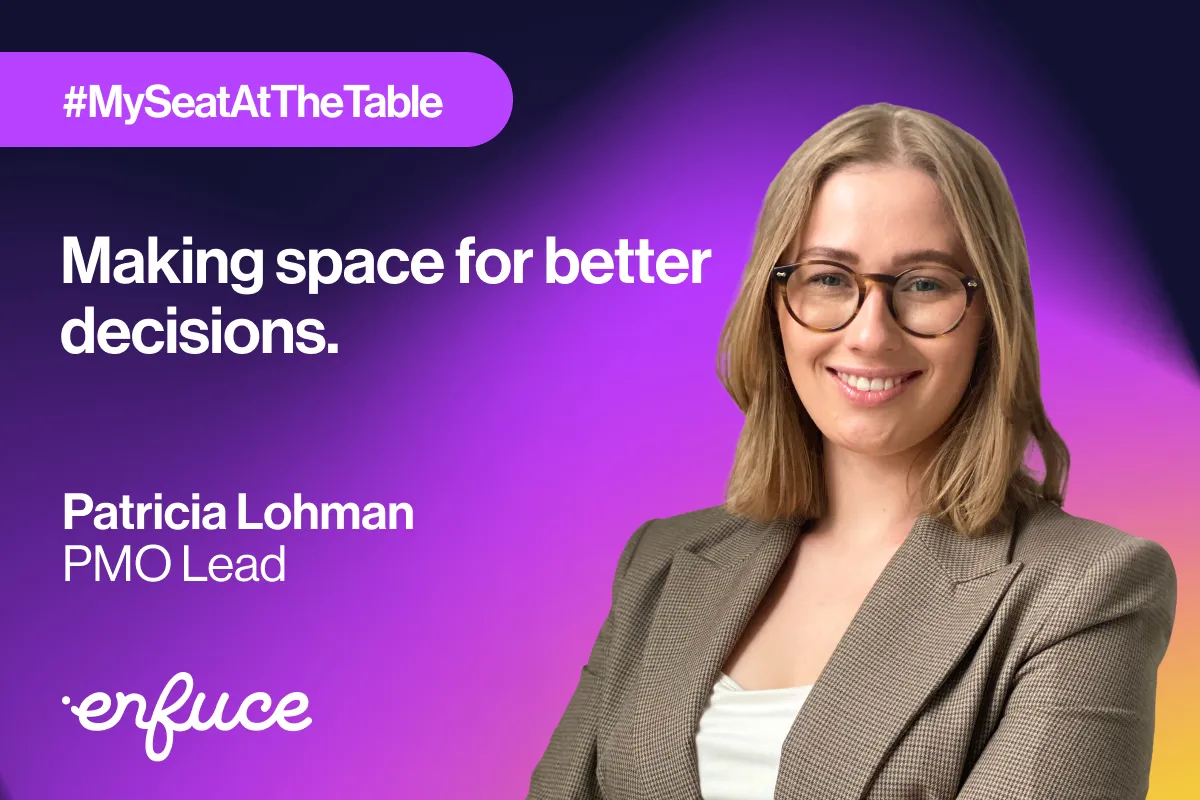
This time, we sit down with Patricia Lohman, our PMO Lead, whose role sits at the intersection of strategy and operations. From building structures that enable teams to work better, to shaping how ideas turn into action, her work is all about making things function, not just on paper, but in practice. We talk about what it really means to have a seat at the table, why inclusion should be constant, not conditional, and how creating space for different perspectives leads to better outcomes for everyone.
Because a seat at the table is where influence begins and real change takes shape.
Let’s start with you. What is your role at Enfuce, and what’s something about your job that might surprise people?
I am the PMO Lead at Enfuce, a role focused on building and driving the Project Management Office while working across a broad range of topics and initiatives. The position combines both strategic and operational responsibilities, with a strong connection between the two. Operational development is designed to influence operational strategy, while organisational strategy is embedded into day-to-day operations.
What might surprise people about my role is that it’s not about blindly enforcing documented rules. Instead, it’s about ensuring processes are designed in a way that enables efficient, structured ways of working while aligning with the needs of different departments.
International Women’s Day has been around for over a century. What do you hope we’ll finally be celebrating one day?
I hope that one day we will only need to celebrate the history of women gaining equality across all layers of society. My hope is that International Women’s Day will become a day of remembrance – honouring the movements, actions, and defining moments when women broke barriers and shattered glass ceilings. This history deserves to be celebrated, both as recognition of those achievements and as a reminder to current and future generations that the sacrifices and efforts of those who came before us should never be forgotten.
At the same time, I feel we are at a pivotal moment in history. In some ways, a new generation of women may be beginning to take the progress that has been made as a given, which makes remembering and appreciating that history even more important.
Was there a moment at Enfuce when you felt your seat at the table truly mattered?
There isn’t a single moment when I felt my seat at the table mattered – at Enfuce, it matters constantly. It’s truly meaningful to work in an environment where you don’t have to question your belonging.That sense of inclusion is something special, and it’s important that we continue to nurture and value it as a core part of Enfuce’s culture.
In your role, what does sharing the table mean to you?
Sharing the table is a foundational principle for me. It enables solutions, products, and processes to be designed with the perspectives of all affected stakeholders in mind, ensuring that different viewpoints are considered from the start. It also creates space for open discussion and communication when decisions may not be ideal for everyone, but still beneficial for the broader group.
This kind of inclusion also strengthens long-term thinking. When different perspectives are part of the conversation, organisations can build visions and roadmaps that are more robust and well considered, with the end result shaped by a wider range of experiences and insights.
If you could invite three women, alive or from history, to sit at your table for one meaningful conversation, who would they be and what would you ask them?
If I could invite a few women to sit at my table for a meaningful conversation, I would choose Eva Wahlström, Lady Gaga, Marie Curie, and – rebelling slightly against the request for only three – Rosa Parks.
With Eva Wahlström, former WBC female super-featherweight world champion, I would want to talk about what it truly means to take the centre and keep yourself there. In boxing, the centre of the ring is both literal and symbolic—it represents control, presence, and confidence. That mentality of claiming and maintaining the centre is something she has already taught me, but I would love to go deeper into how she developed that mindset through boxing and how she thinks about maintaining ownership of space, both inside the ring and beyond it.
With Lady Gaga, the conversation would revolve around inclusion and self-acceptance. I would want to understand how she has navigated being unapologetically herself in the public eye, while also creating spaces where others feel accepted and empowered to do the same.
With Marie Curie, I would ask about her experience contributing to STEM at the highest level while being surrounded by men in a field that was not built for women at the time. I would be fascinated to hear about the personal navigation she had to do as a scientist and as one of the first women to be widely recognised for her work.
And finally, Rosa Parks. I would want to focus on the aftermath of her act of refusing to give up her seat on a segregated bus, and how she navigated the reality of becoming a central figure in a movement. I would be interested in understanding the pressures and expectations that followed, and how she chose to continue supporting the broader civil rights cause after that defining moment.
If you could give one piece of advice to your younger self on her first day in the job market, what would it be?
Remove yourself from environments that restrict your curiosity, the flow of ideas, or the ability to discuss them openly. Not every idea will be actionable, but exploring and sharing them remains important for personal growth and development.
If this conversation had a soundtrack, what song would be playing in the background?
After spending the most time reflecting on this question out of all those in this blog, I chose Ariana Grande’s “Yes, And?”. To me, it represents kindness toward oneself while still embracing the agency and determination to move forward and take action. It also reflects the ability to acknowledge the opinions of others without letting them weigh too heavily, not getting stuck in endless overthinking but continuing to move forward and get things done.
Thank you, Patricia, for sharing your story and perspective. It’s a powerful reminder that real progress happens when people are given the space to speak, challenge and create change.
Curious to hear more? Explore the rest of our My Seat at the Table series on our blog and discover the voices shaping what comes next.