Can you afford the hidden costs of your legacy fleet platform?

There’s a growing gap between what legacy fleet systems were built for and what modern commercial fleets need.
Traditional solutions typically support two main fuel types in a handful of markets. Modern fleets need to manage fuel, EV charging, tolls, parking, overnight accommodation, and other expenses associated with cross‑border travel.
This capability gap rarely shows up as a critical outage, but the hidden costs are real: higher operational risk, more manual work, weaker controls, fragmented reporting, and slower launches.
Enfuce replaces this patchwork of bolt‑ons and workarounds with one coherent mobility programme designed for today’s fleets. One that replaces parallel layers with a single framework connecting fuel, EV charging, and all other on‑the‑road payments.
Legacy fleet systems are a product of their time.
When transactions are consistently authorised and funds move as expected, the logical conclusion is that your fuel card platform ‘works’.
Except, legacy fleet card systems were designed for a world where petrol and diesel, bought from well‑defined networks, made up most of the spend, reporting was periodic, and cross‑border journeys were the exception. Today, that’s not the case.
Increasing electrification means fuel card platforms can no longer just cover petrol and diesel. They must also cover EV charging.
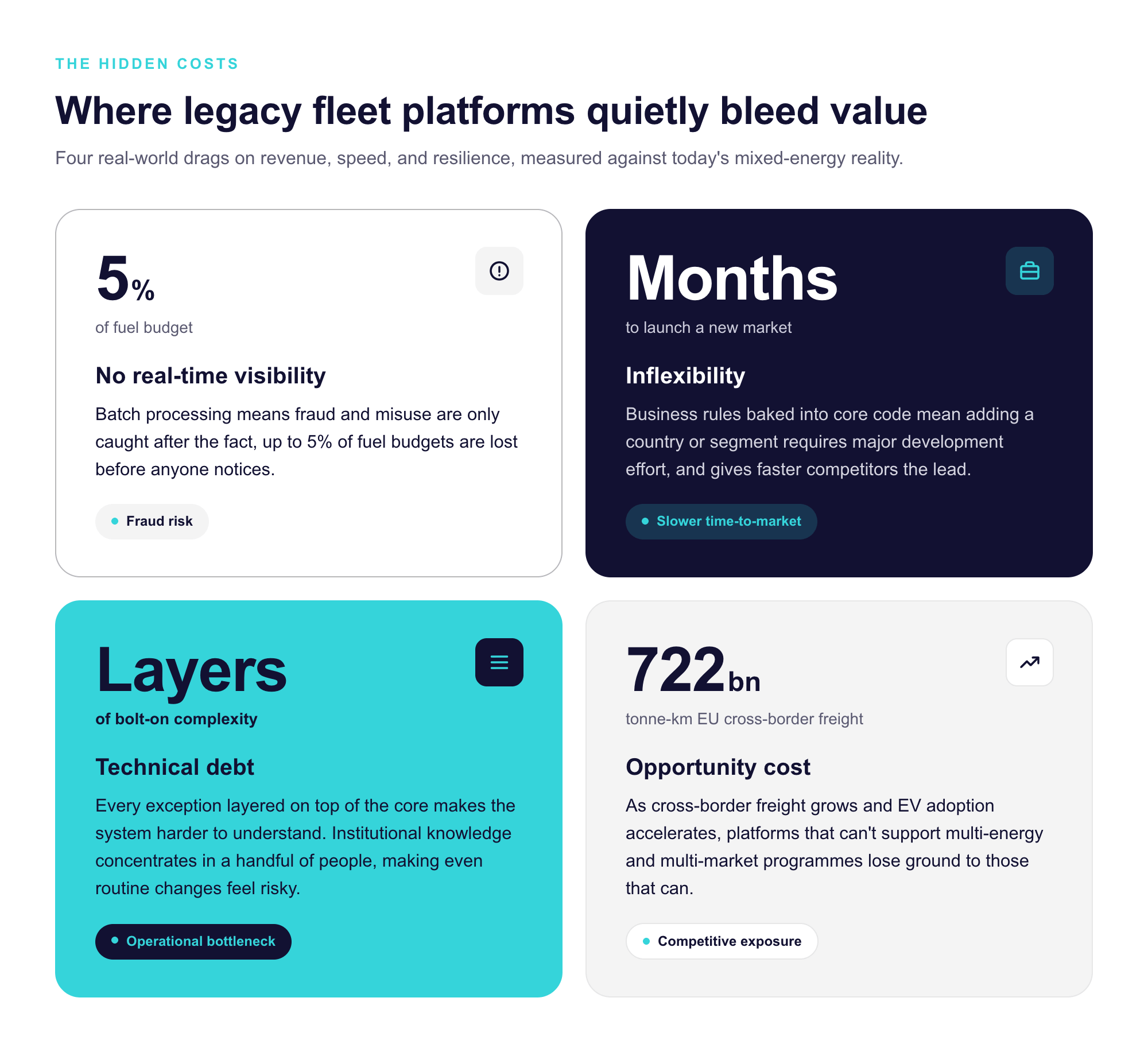
Cross‑border volumes are also growing – 722 billion-tonne kilometres, or around a quarter of all EU road freight, according to the latest Eurostat numbers. Longer journeys drive more spending on food, accommodation, tolls, parking, and other on‑the‑road costs.
At the same time, tight delivery windows and just‑in‑time logistics mean drivers often can’t afford long detours to in‑network refuelling stations.
These practical realities – and legacy fleet card platforms’ inability to address them without bolt-ons and workarounds, are what leads to hidden costs.
The high costs (and risk) of keeping things as they are
The gap between how modern fleets work and what legacy fleet systems were designed to do isn’t always outwardly visible. But the costs, though hidden, are very real.
The cost of not having real-time visibility.
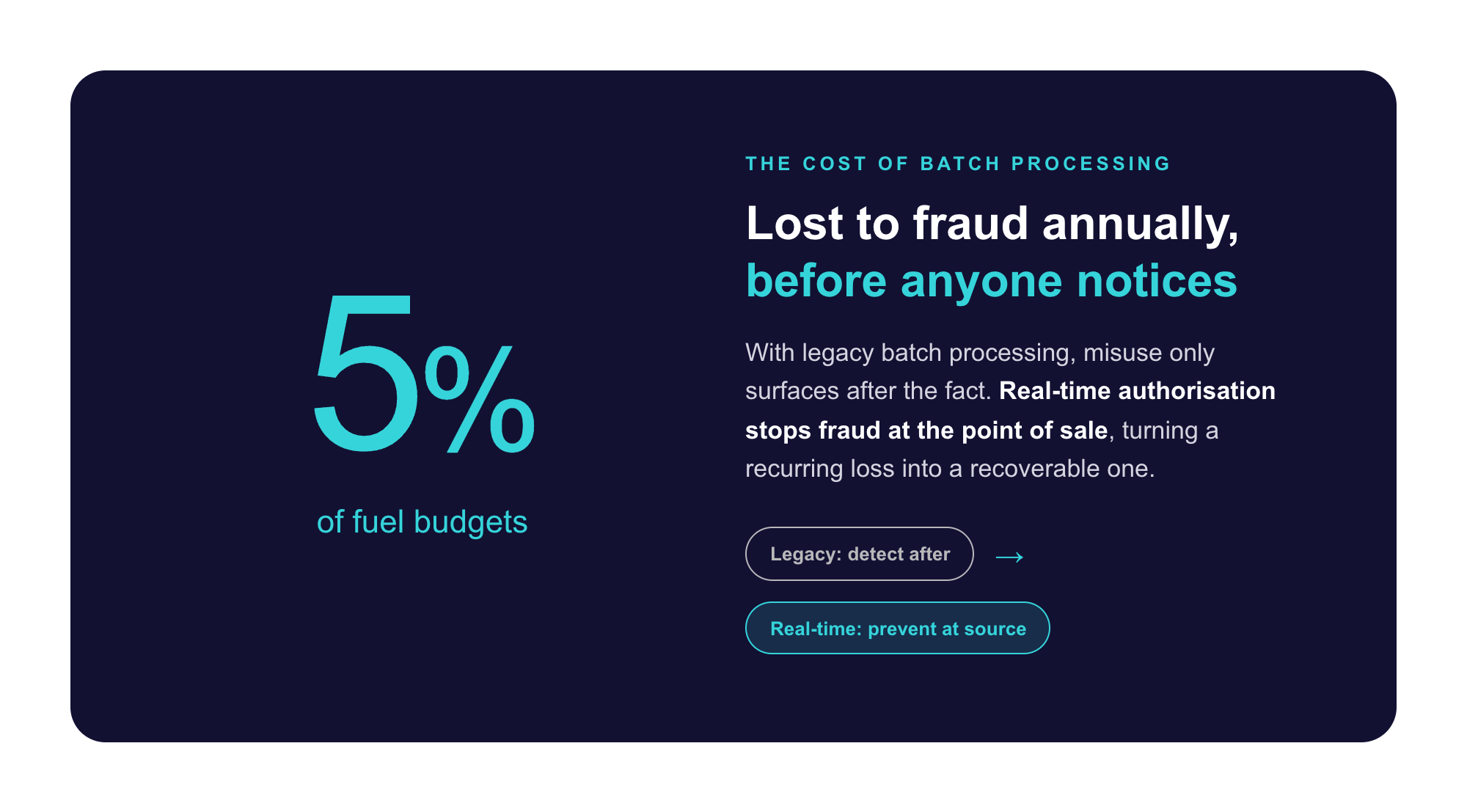
Batch processing means misuse and fraud only becomes apparent after the fact. At that point, the damage is done.
Real-time processes, on the other hand, would make it possible to stop fraud straight away. With up to 5% of fuel budgets lost to fraud, the saving from real-time processing is significant.
Not having real-time visibility also creates operational risk. It’s harder for end-clients to track their fleets’ status at a glance, for instance, which could result in spend leakage and slower responses to misuse. Similarly, fuel card platforms could struggle to deliver value-added services such as route optimisation on top of their programme.
The cost of inflexibility
Because legacy tech often has business rules that are baked into the core code, even relatively simple changes – such as adding a new country or customer segment – may need major code modifications.
That drives up development and testing effort and increases the risk that a faster competitor might reach the market first.
Legacy architecture also makes it harder to connect the payment layer with fleet software, telematics, accounting, self-service tools, and back-office workflows. When APIs are weak or inconsistent, even straightforward integrations become slower and more expensive, limiting automation and delaying digital service improvements.
Where it’s only possible to create bolt-ons or parallel systems – for example EV charging or mobility costs that the core doesn’t natively support – the trade-off is siloed data, more complexity, and more maintenance.
If legacy tech pre-dates the latest PCI-DSS standards or lacks scheme support, moving to open loop issuing also becomes more challenging. Similarly, weak or limited API support means more manual intervention and a poorer user experience for internal staff and end-customers.
The upshot is that products take longer to launch and development costs are higher. There’s also an opportunity cost: longer time-to-market for new countries or segments, and weaker competitiveness as fleet requirements change.
The cost of technical debt
Inflexibility also increases the hidden cost of legacy fleet card systems by creating technical debt.
New spend categories, merchant deals, and compliance updates are layered in as exceptions rather than rethinking the core, so no one has a complete view of how authorisation rules, fee logic, and acceptance lists now fit together. Often, institutional knowledge of the system is concentrated in a handful of people, which creates further bottlenecks and makes even routine changes feel risky.
Adjusting a spend control, adding a new merchant category, or updating a tax rule requires investigation and impact assessment, because it might have side effects that are hard to predict.
Over time, this slows product development, increases risk aversion, and makes it harder to adapt your fleet and mobility programme to new fuels, markets, or regulations, while outdated processes stay in place longer than they should.
What good looks like: Build unified, hybrid-ready fleet card technology with Enfuce
If we accept that the traditional fleet model is now the exception, not the rule, it follows that it can no longer be fleet card platforms’ core use case.
To improve drivers’ experience, and make audit, compliance, and reporting easier, you need a single, coherent framework. Infrastructure that runs all fleet and mobility spend through one governed system, not separate stacks.
Enfuce provides this foundation.
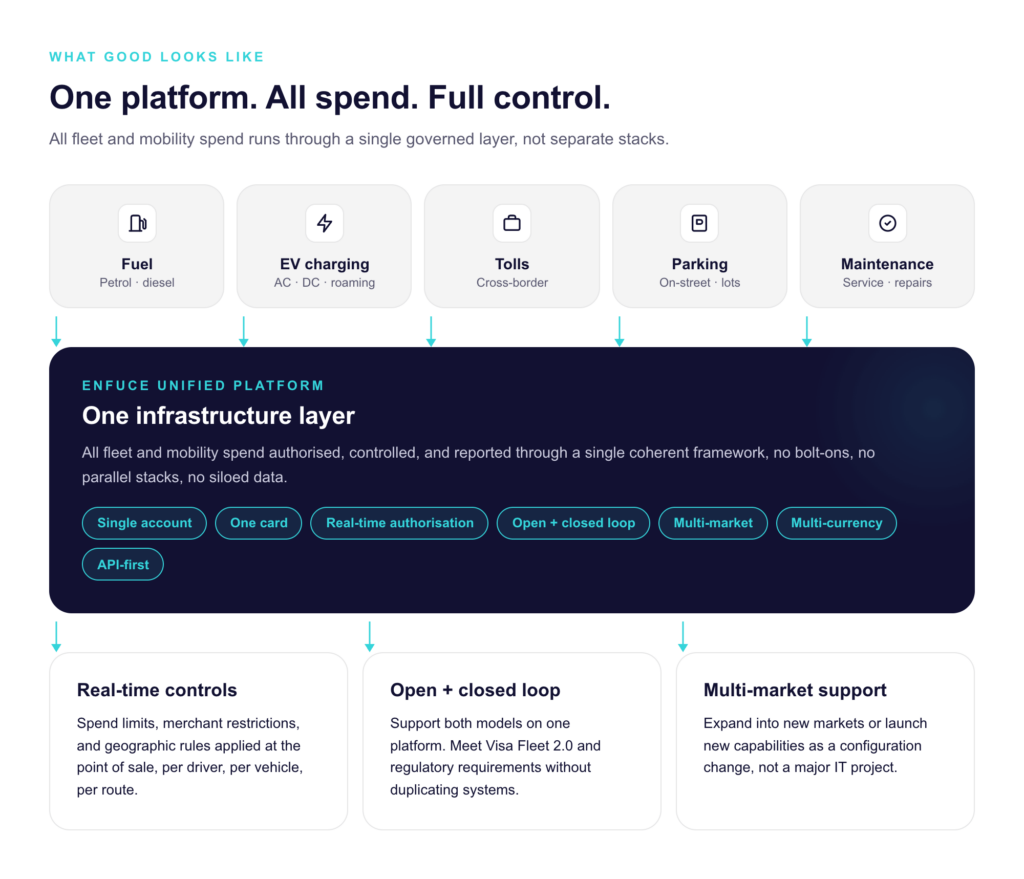
It supports mixed‑energy fleets by default – petrol, diesel, and EV charging – as well as tolls, parking, maintenance, and other on‑the‑road expenses on a single account. Real‑time authorisation controls and data make it easier to prevent misuse at the point of sale and give end-customers live visibility of their fleets.
The core platform is also designed for multiple markets, products, and currencies, so expanding into a new market or launching a new capability or use case is a configuration issue, not a major IT undertaking. Our APIs let you build digital self‑service and automate back‑office processes without fighting the core system.
Perceived stability, not change, is the real risk
When objectively small, everyday decisions start feeling too risky, it’s a strong signal that your legacy platform is overstretched. Even if outwardly, it still looks like it’s getting the job done.
EV-focused add-ons, purpose-built cards, and other capabilities built on top of your core layer might give the impression you’re evolving with customer demands. But, in reality, they’re fragmentation disguised as progress: you’re solving an immediate problem while introducing more complexity and more fragmented data and controls, making the programme harder to manage over time.
There comes a point where it’s safer and more effective to replace legacy fleet card technology with one infrastructure foundation that can handle fuel, EV charging, and wider mobility spend, than to keep tinkering with a platform that was never designed to support hybrid fleets, real-time controls, and cross-border mobility.
Enfuce can help you transition from this inefficient and costly patchwork to a coherent, real-time programme that’s in line with your practical needs and supports your growth.